Join the Christmas Bird Count – A great Citizen Science Opportunity! (Takes Place Between December 14th and January 5th)

Photo: By Jeff Drake, Carolina Chickadee – From the Great Backyard Bird Count

The National Audubon Society’s Christmas Bird Count is one the longest running wildlife censuses in the world. The CBC began on Christmas day in 1900 as a way to conserve America’s natural heritage by counting birds rather than hunting them. This year is the 127th anniversary of that first CBC, when birders across the entire Western Hemisphere will get up early to count birds from December 14 to January 5, 2027.

Participation is free and open to bird enthusiasts of any level. There are two main ways to participate:

  • Feeder Counts: Count all the birds you see or hear from your own backyard or local park at a stationary bird feeder within a CBC circle. No binoculars or hiking required, and you can participate with less time commitment.
  • Field Counts: Survey an area (alone or in groups) during daylight hours and record all the birds you see or hear. Some counts also include nocturnal surveys after dark to record owls and other night-active species.

Visit the CBC Circle Finder to locate a count near you and register to participate. All skill levels are welcome!

Christmas Bird Count Circle Finder

Why Count Birds?

It’s a way for volunteers to monitor environmental trends in our local area, identify potential problems and share data with other organizations. Birds are the “canary in the coal mine” for our environment. Their health, abundance and distribution can signal trends in the health of the larger environment. NVBA has a long history of documenting bird life in our community and promoting conservation of birds and wildlife.

Resource managers of parks and other public lands rely on bird count long-term and geographically fixed data in their land management decisions. NVBA sends the count results to organizations—like the Fish and Wildlife Service, Bureau of Land Management, and the National Park Service—who use the information to better manage their natural resources.

Without habitat, we would have no birds.  Eleven percent (11%) or 1,111 of the world’s species of birds are at risk. Two hundred could disappear within 20 years. The primary threat to birds is habitat loss. Since 1967, there’s been a 70% decline in common backyard birds because of habitat fragmentation or development.

Your counting counts! Even if you’ve never participated in a count or survey before, you’ll be matched with more experienced volunteers who can teach you the “tricks of the trade” and help you build new skills that will add to your bird-watching enjoyment. Plus your efforts will make a difference in helping to protect our local habitats.


The information above comes from the Northern Virginia Bird Alliance Website.
Virginia Association for Environmental Education (VAEE) Annual Conference February 25-27, 2027

Image: Courtesy of The Virginia Association for Environmental Education


VAEE is excited to bring the Annual Conference back to the Northern Virginia area February 25-27, 2027 at the Hilton Fairfax, and they are currently accepting session proposals! They hope you will consider submitting your proposal as they meet to celebrate Learning That Moves Us.

Proposals are due by October 16, 2026. Please follow this link to submit your proposal.

What moves you? What are you driven to change, to embrace, to learn, to share? What makes you want to lean in and learn more? We are all lifelong learners and connected by our love of learning. This conference brings together environmental educators, teachers, researchers, community leaders, policymakers, partners, and learners from across Virginia. Together, attendees explore and share the learning and education practices that move and inspire us to make our communities and the commonwealth a better, more resilient place to live and thrive.

Organizers are seeking proposals for conference sessions that engage, educate, and move attendees with the goals of making our collective EE practice in Virginia stronger and more resilient. They encourage presenters to consider how their sessions will engage their audience – hands-on activities, group discussions, and collaborative work sessions are a few examples that create a more memorable and meaningful experience for session attendees.

This year’s concurrent sessions will be categorized according to these tracks:

  • Building Leadership in EE – building leadership skills, fund-raising strategy, board development, maintaining professional standards, resume building workshops, leading successful meetings, engaging board and volunteers, etc.

  • Collaboration in Practice –  connections between formal and nonformal educators, transdisciplinary and cross-curricular connections, building partnerships and networks, uplifting the EE community, etc.

  • Research, Evaluation, and Impacts – recent research in the EE field, assessment and evaluation tools and tips, application of best practices, enhancing student engagement in EE, developing environmental literacy plans, etc.

  • Reaching Diverse Learners – creating belonging for a diversity of learners, working in a variety of spaces, creating inclusive learning environments, reaching underserved/underrepresented audiences, providing new/increased resources to meet learner needs, etc.

  • EE in Action – successful projects and programs, lessons learned, sharing activities/lesson plans/resources, etc.

Three different Session Lengths are available:

  • Lightning-style mini sessions (15 minutes or less)

  • Standard sessions (45 minutes)

  • Workshop sessions (1 hour 45 minutes total; includes a 10-minute break)

Proposals are due by October 16, 2026. Please follow this link to submit your proposal.

Please also consider submitting a nomination for the 2027 VAEE Awards for Excellence in Environmental Education! Organizers are excited to celebrate exemplary educators and programs from 2026. Award categories include the Environmental Education Program of Excellence, Outstanding Environmental Educator of the Year, Exemplary Service to EE, Young Professionals, and Legacy Awards. Learn more and submit your nominations here.

The 34th North American Invasive Species Management Association (NAISMA) Annual Conference Is Headed to Alexandria, VA – October October 19–23!


Logo: North American Invasive Species Management Association (NAISMA)

NAISMA’s 2026 Annual Conference will take place at the Hilton Alexandria Mark Center, just minutes from Washington, D.C. This event brings together invasive species management professionals, researchers, educators, and policymakers from across North America to share ideas, innovations, and strategies for protecting natural ecosystems.

The NAISMA Annual Conference is your opportunity to connect with leading professionals, discover the latest innovations in invasive species management, and contribute to shaping the future of our field. From engaging keynotes to hands-on workshops, this event offers a rich program for attendees from diverse backgrounds.

Event Details:
  • Dates: October 19–23, 2026 

  • Location: Hilton Alexandria Mark Center, Alexandria, Virginia (near Washington, D.C.) 

  • Theme: Local Leadership – Global Impact
  • Full Agenda: – Click here!

  • Registration Rates:
    • Full Conference Registration: $600
    • One-Day Registration: $315
    • Student Full Conference: $370
    • All-Access Conference Bundle: $824 (includes full registration, banquet ticket, field experience, and a one-year NAISMA membership)
  • For more conference information please click here!
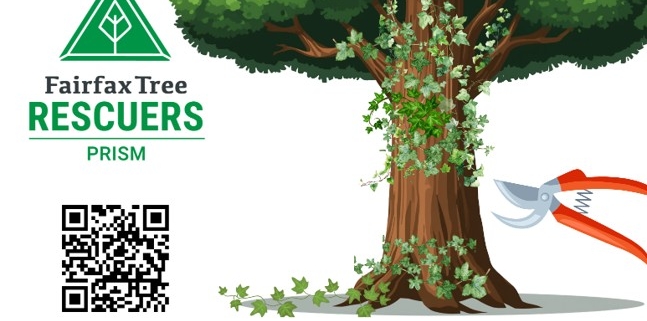
Image Courtesy of Fairfax Tree Rescuers Prism

Fall Tree Rescue Extravaganza II, October 3rd to November 1st


Image: Courtesy of Fairfax Tree Rescuers Prism

Fall Tree Rescue Extravaganza II takes place across various locations and times during the four weekends of October 2026 (running from October 3 to November 1) to help save local trees from invasive vines. No experience necessary!

What to Know Before You Go

What to Wear: Long-sleeved shirts and long pants to protect against thorns, sturdy shoes, a hat.

What to Bring: Water. See instructions for each event about tools. If you have them, bring clippers, loppers, and/or small saws. If you don’t, most event leaders will have some extra tools you can borrow.

Sign Up: Please use the registration form or link on the calendar to let the event leaders know you are coming. Children must be over age 11 to actively participate.


Would you rather help in other ways?

Volunteer to help organize? Please fill out the interest form.

Donate money to support the work of the PRISM or adopt parks? Please see this page. 

Featured October 2026 Events – Click here for specific event details and restistration information:

  • Tree Rescue at Colvin Run Park
  • Stanton Park Tree Rescue – Sunday, October 4, 2026 at 9:00 AM
  • Tree Rescue at Laurel Hill Park Central Green – Saturday, October 17, 2026 at 9:00 AM
  • Brentwood Farm Park Tree Rescue – Sunday, October 18, 2026 & Sunday, October 25, 2026 at 9:00 AM
  • Vienna Klub Kudzu Southside Park – Mondays, October 5, 12, 19, & 26  at 10:00 AM until 12:00 PM
  • Centreville Pleasant Hill Park – Monday, October 12, at 1:00 PM until 3:00 PM
  • Brentwood Farm Park Tree Rescue – Sunday, October 18 at 9:00 AM until 11:00 AM
  • Reston Hunters Green – Saturday, October 24 at 2:00 PM until 4:00 PM
  • Burke Rolling Valley West Park – Saturday, October 24 at 10:00 AM until 12:00 PM
  • Herndon Horsepen Run Stream Valley Park –  Saturday, October 24 at 9:00 AM until 11:30 AM
  • Fairfax South Railroad Street Park – Sunday, October 25 at 10:00 AM until 12:00 PM
  • Fairfax Brentwood Farm Park Tree Rescue – Sunday, October 25 at 9:00 AM until 11:00 AM
  • RestonTree Rescue at Lake Fairfax Park – Saturday, October 31st at 9:00 AM until 11:30 AM

VDoF Acorn Collection 2026 – Part 2

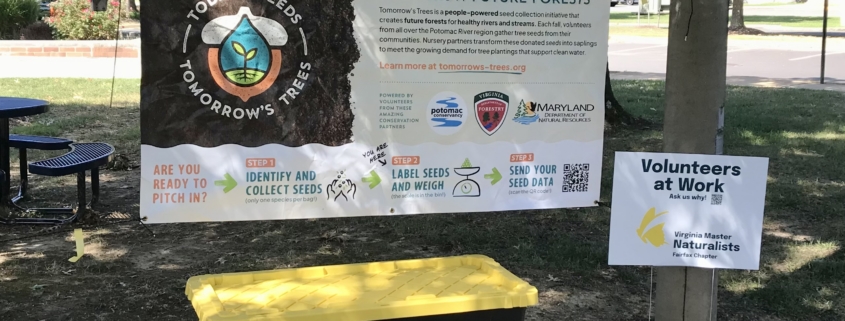
The VA Department of Forestry (VDoF) Acorn and Seed Collection Program was established to sustain the native tree population in Virginia by collecting native tree seeds, raising trees on farms, and reforesting areas that may have been destroyed by fire or disease. For 2026, Virginia Master Naturalists has again partnered with VDoF to collect various acorns and tree seeds. Please check-out VDoF’s sustainability program link for collection hints, a seed identification chart, and details of seed types being collected for 2026:

Acorn and Nut Sustainability Program : Virginia Department of Forestry

Collection period for 2026 is September 8 thru October 11.

Process Changes for 2026:

Each FMN collection site will have a manager. Please contact the listed manager with questions or to help administer the site (monitor bin or transport seeds).  Otherwise simply drop off acorns in appropriate containers as they are collected.

Notably, the Fairfax County Government Center (Herrity building) is NOT a drop spot for 2026. Due to this reduction in collection capacity we are asking FMN to please REDUCE the donation of Black Walnut nuts (drupes) this year. Because the Herrity Building is not available, our smaller bins and transport resources may be stressed by the volume created by walnut donations. This will be a test year for that. Please focus on donating acorns for any of the 15 types of oak and chestnut species listed on the VDoF site.

FMN Collection Bin Locations:

Fairfax City Composting Center – Sophia Chapin, Stewardship Coordinator 703.223.5054, Sophia.chapin@fairfax.gov

Hidden Oaks Nature Center – Kristina Watts – Kristina.watts@fairfaxcounty.gov

Mt Vernon District Governmental Center – Jerry Nissley – jerry14niss@gmail.com

Vienna Community Center – Maryam Dadkhah – Maryamdad@yahoo.com

Walker Nature Center – Charles Colby – Charles.L.colby@gmail.com

Collection bags will not be provided, so please use sturdy paper, cloth, or canvas bags.

VDoF Collection requirements:
1. Please DO NOT collect acorns or any seed in plastic bags. They will mildew and spoil.

2. Please separate different seed types into separate bags and include a leaf from the tree to help with positive identification.

3. Please label the bag with type of seed, collection date, collection site (zip code at least) and approximate weight.

4. Acorns need to be clean (no holes). Holes indicate that a grub has bored into the acorn. If an acorn floats on water, it is not viable and cannot be used by VDoF – please toss it.

Record FMN service Hours: S400: VDoF Acorn and Seed Collecting — (VDoF)

VDoF Acorn and Seed Collection – 2026

The VA Department of Forestry (VDoF) Acorn and Seed Collection Program was established to sustain the native tree population in Virginia by collecting native tree seeds, raising trees on farms, and reforesting areas that may have been destroyed by fire or disease. For 2026, Virginia Master Naturalists has again partnered with VDoF to collect various acorns and tree seeds. Please check-out VDoF’s sustainability program for an identification chart and seed types being collected for 2026:

Acorn and Nut Collection link : Virginia Department of Forestry

Process Changes for 2026:

Each FMN collection site will have an FMN manager. Please contact the manager (TBD) with questions or to help administer the site (monitor bin or transport seeds).  Otherwise simply drop off seeds in appropriate containers as they are collected.

Notably, the Fairfax County Government Center (Herrity building) is NOT a drop spot for 2026.

FMN Collection Bin Locations have not all been confirmed for 2026. Sites will be announced via a Listserv message very soon. The DoF link above indicates detail will be announced in early September. At the time of this article, FMN is waiting for final process details from DoF.

Collection requirements:
1. Please DO NOT collect acorns or any seed in plastic bags. They will mildew and spoil.
2. Please separate different seed types into separate bags and include a leaf from the tree to help with positive identification.
3. Please label the bag with type of seed, collection date, collection site (zip code at least) and approximate weight.

Record FMN Hours: S400: VDoF Acorn and Seed Collecting — (VDoF)

Upcoming Smithsonian Environmental Research Center (SERC) webinars for September and October

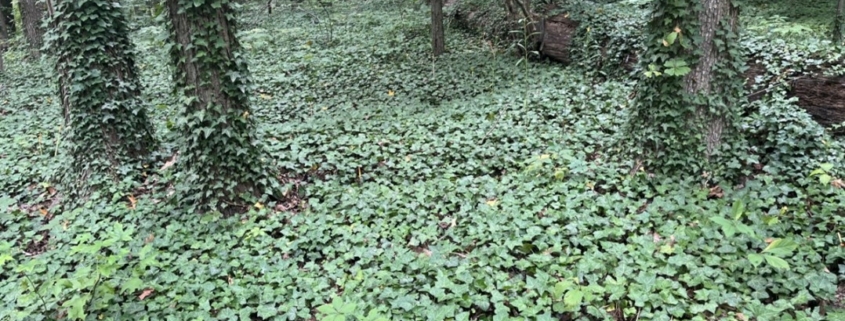
Photo courtesy of Nina Fisher – English ivy on a forest floor


These events is part of the Smithsonian Environmental Research Center (SERC)’s free evening science talks, and it will be recorded! Closed captions will be available during the live stream and on the recording. By signing up on the presentation’s Zoom link, you’ll be able to watch live and receive a link to the recording a few days after the live stream. SERC seeks to showcase a wide variety of topics and perspectives for its evening science talks. Views expressed during these talks belong to the individual speakers and not the Smithsonian.

Tuesday, September 15, 2026

  • 7:00pm – 8:30pm

    Speaker: Sam Droege, USGS Patuxent Wildlife Research Center

    Maryland has about 450 species of bees. Like birds, some are common and some are rare and may need help from people to flourish.  It turns out that many of the rare bees are highly specialized, meaning they gather pollen from only a one genus of plant, or sometimes from just one species of plant. If those plants are absent, then the bees are absent too.  In this webinar, wildlife biologist Sam Droege will highlight some of the successes of bringing those bees back via plantings in yards and properties—including things local residents can do in their own backyards.

Tuesday, October 20, 2026

  • 7:00pm – 8:30pm

    Speakers Nina Fisher and Ginger Woolridge, Save Our Trees

    Invasive vines—such as English ivy, bittersweet, wisteria, and Japanese honeysuckle–can stress and ultimately kill ​ trees, causing serious ecosystem disruption. In our October webinar, Nina Fisher and Ginger Woolridge, two of the five co-founders of Save Our Trees in Maryland’s Anne Arundel County, will discuss the most prevalent invasive vines in Maryland. They’ll outline the harm they cause, how to remove them correctly and how to prevent them from returning, along with a discussion of some native species you can plant instead. They will also cover proper mulching technique, creation of “soft landings” for beneficial insects, and preparation of your yard for autumn and winter.

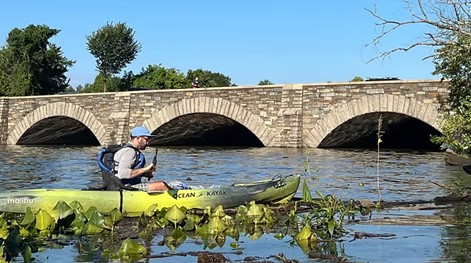
Fall Kayak Clean Up, September 20th

Photo: Courtesy of the Northern Virginia Conservation Trust

September 20, 2026
3:30 PM – 5:30 PM

Registration and additional information click here.

Porto Vecchio Condominiums
1250 S Washington St
Alexandria, VA 22314

Help Northern Virginia Conservation Trust and the Potomac Conservancy clean up the Hunting Creek watershed adjacent to Interstate 495! The trash and debris that pile in from the Potomac River and Cameron Run harms the environment and hinders outdoor activity around the area. Organizers hope you’ll jump in a single or double kayak and join them for the annual cleanup.

Please fill out one registration form for each participant. If the participant is under the age of 16, they must be accompanied by a parent or guardian at the event and in a kayak. Please have their parent or guardian fill out their waiver at the cleanup.

Please let organizers know if you are no longer available to make the event so they can open a spot from the waitlist. They have a limited amount of boats.  Once they fill that capacity they will be placing registrants on the waitlist. If you need a boat and register after all the boats have been filled, they will contact you to notify you that you have been placed on the waitlist and will be in touch if a spot opens up.

All participants must complete waivers at the event! Reach out to Amelia Wilt at awilt@nvct.org with any questions.

Funding for this clean-up is provided by the Virginia Outdoors Foundation.

Loudoun Wildlife Conservancy Fall Native Plant Sale, September 12th


Saturday, September 12, 2026
9am-2pm


Morven Park
17195 Southern Planter Ln, Leesburg, VA

Native plant vendors include Hill House Farm & Nursery, Nature by Design, Watermark Woods, Seven Bends Nursery, and Yellow House Natives.
See Loudoun Wildlife Conservancy website and facebook page for details.


Soldiers to Scientists – First Activity

Hello FMN volunteers – nature sojourners, citizen scientists, outdoor enthusiasts, and nature journalists.

FMN recently added Soldiers to Scientists as a chapter partner and created two activity codes to record support hours for relevant projects (E170: Soldiers to Scientists Educational Projects and S170: Soldiers to Scientists Service Activities, under Community Outreach).

Nature Journal example

Through SciStarter ,  S2S recently connected with Metropolitan Washington MENSA and they would like to hold a bioblitz at Dora Kelley Nature Park in Alexandria on Saturday, September 26th (roughly 8:30 – 12:00). After exploring the park in small groups with VMN support (both ARMN and FMN volunteers), S2S would like to conclude with reflections and nature journaling. Dora Kelly Nature Park runs along Holmes Run Stream Valley adjacent to the Buddie Ford Nature Center.

S2S created a SignUp Genius soliciting 12 volunteers interested in education and outreach, nature journaling, and working with a youth audience, and/or citizen science contributions to iNaturalist.

Please join together with S2S, SciStarter, VMN, and MENSA on this uniquely cooperative project.

ARMN Project Lead – Terri McPalmer terrimcpalmer@gmail.com
ARMN Chapter Contact – Laura Gilmore 240-205-1355 lauritagilm@gmail.com

FMN Chapter Contacts – Jerry Nissley jerry14niss@gmail.com  // John Goodin johntgoodin@gmail.com