Beech Leaf Disease (BLD)
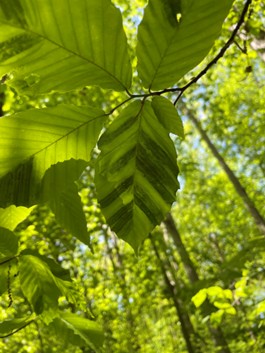
Photo: Courtesy of FCPA, Beech Leaf Disease observed in Burke Lake Park
The following Information comes from the Urban Forest Management Division Annual Report Fiscal Year 2024, Released April 2025
Beech Leaf Disease (BLD)
What is it?
BLD, a relatively new disease of native American beech as well as other
Fagus/beech species, is caused by a foliar-feeding nematode (a
microscopic roundworm). The nematodes enter the tree’s leaf buds in
the fall where they overwinter, multiply, and feed on newly forming
leaf tissues. The nematodes further multiply and spread throughout
the tree from year to year until leaf buds no longer produce leaves.
As healthy foliage decreases, the tree’s energy, nutrient, and water
uptake decreases, and the tree eventually dies.
Why is it a problem?
Beech trees are critical to the native forest ecosystem, providing
food for a wide variety of wildlife, and bearing nutrient-rich fruit with
seeds that last through the winter and serve as a food source when
other plants have long stopped producing. There are approximately 4.3
million beech trees in Fairfax County, making them tied with red maple
for the County’s most common tree species. BLD, nearly 100% fatal,
is spreading rapidly; and there is no known safe treatment option for
forested environments.
What is being done?
County staff achieved the following results and milestones in FY 2024:
Mapped 6 infestations totaling 60 acres at regional and County parks (previously 13 acres in FY 2023).
Established 4 monitoring plots in beech stands confirmed to have, or at high risk of developing, BLD.
Participated in a comprehensive U.S. Department of Agriculture (USDA) Forest Service study spanning the full geographic reach of
both BLD and beech bark disease.
Hosted a webinar—“Unraveling the Mystery”—in partnership with Virginia Cooperative Extension (VCE) to raise awareness.
Contributed BLD samples for a regional nematode DNA study out of the University of Connecticut.
How YOU can help!
– First, learn to IDENTIFY early symptoms of the disease, infected leaves, and other diseases that can appear like BLD.
– REPORT sightings on iNaturalist, an easy-to-use app that shares information with community scientists.
– And finally, PRACTICE good tree care such as proper mulching and watering during droughts; and be considerate and responsible when it
comes to selecting soil treatments and other landscaping services.
This report is in PDF format which allows you to search for other pest like the hemlock woolly adelgid, and the spotted lanternfly..

