

Geochemistry in Nature
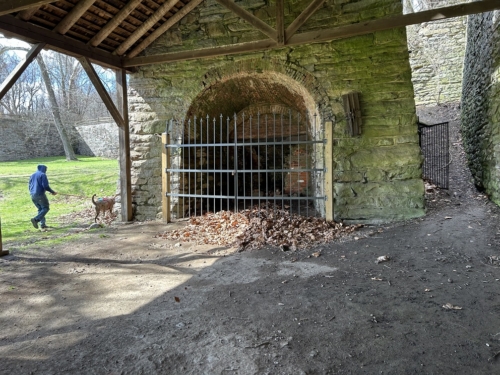
Feature photo Catoctin Iron Furnace: Soil and hearth sediments preserve chemical markers. For example, testing the chemical matrix of industrial slag identifies the efficiency of historical furnaces and the type of ore processed. Pebbles and grains remaining on the property are easy to find. A magnet can attract magnetic pulverized ore around the furnace. Small chips of limestone/dolomite rock used in the process will “fizz” in the presence of dilute hydrochloric acid.
Photos and article by FMN Stephen Tzikas
Master Naturalist training usually includes modules on geology, soils, and environmental science. When combined with chemistry, a large field of geochemistry emerges. Geochemistry involves chemical reactions that can be useful for master naturalist citizen science. Geochemistry can include water quality monitoring, soil sampling for contaminants, and tracking environmental factors affecting ecosystems.
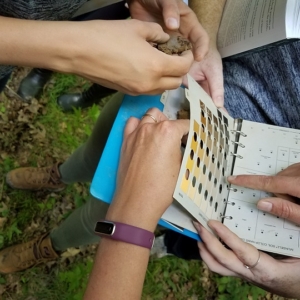
A Munsell chart and soil sample examines wetland geochemistry and soil characterization on how prolonged saturation and low oxygen (anoxia) drive unique chemical, biological, and physical processes. These hydric soils act as reactive biogeochemical filters that transform nutrients, sequester carbon, and control trace metal mobility.
In geochemistry, elements are categorized by the Goldschmidt classification, which groups them based on their natural affinity. This system explains how elements partition themselves between Earth’s core, mantle, crust, and atmosphere. The Lithophile (“Rock-loving”) group comprises of low density elements that strongly bond with oxygen to form silicates and oxides, primarily in the Earth’s crust and mantle. The Siderophile (“Iron-loving”) group includes dense metals that dissolve readily in iron, largely segregated into the Earth’s metallic core. The Chalcophile (“Ore-loving”) group elements prefer to bond with sulfur. The Atmophile (“Gas-loving”) group contains elements and compounds that exist as gases or liquids at standard surface conditions, and can be found in the atmosphere and hydrosphere.
A karst environment is a good example of how geochemistry relates to geology. Virginia’s karst landscapes are formed by the
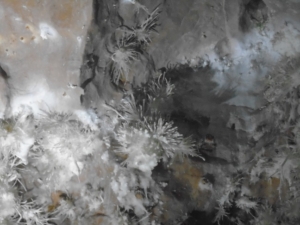
Anthodites are found in karst environments. They are rare, flower-like cave formations (speleothems) made of radiating clusters of needle-like calcium carbonate crystals. Found in Virginia at Skyline Caverns in Front Royal, their unique geochemistry involves delicate growth conditions of pure aragonite or calcite inside isolated, low-airflow subterranean pockets.
dissolution of carbonate bedrock (limestone and dolomite) by slightly acidic groundwater. This geochemical process creates highly porous aquifers, sinkholes, and caves. These aquifers are vulnerable to surface pollution. Karst environments are dominated by lithophile elements (calcium and magnesium), which form the carbonate host rocks. Karst is not defined by the Goldschmidt classification. Instead, Goldschmidt’s system classifies chemical elements based on their affinities, while karst is a geomorphological landscape formed by the dissolution of soluble carbonate rocks. Karst environments cover about 20% of the U.S. and provide a significant portion of the nation’s drinking water.
Geochemistry has a number of sub-disciplines. Environmental geochemistry and climate studies show how chemical cycles change our weather and temperature over time. The carbon cycle tracks how carbon moves between air, land, and oceans, which directly impacts global warming. Anthropogenic influences, such as rising temperatures and contamination, are changing stream geochemistry. Chemical weathering due to rain and wind breaks down rocks, a process that naturally pulls carbon dioxide out of the air. These geochemical processes, including hydrolysis, oxidation, and dissolution, can decompose minerals into clays, release dissolved ions into groundwater, and sequester atmospheric carbon dioxide. In another example related to bio-geochemistry, the U.S. Geological Survey engaged the public in submitting deceased insects to organic geochemistry research laboratories to identify environmental contaminants.
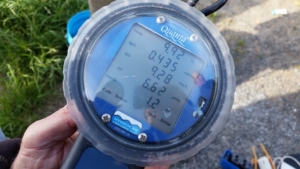
Hydrolab instrumentation measurements, as well as collecting nitrate and salt data in streams over time, shows how geochemistry changes. These measurements track seasonal shifts, human activities, and weathering processes in a watershed.
Geochemistry also intersects with engineering. Soil mechanics is fundamental for designing safe foundations, retaining walls, earth dams, and tunnels.Geochemistry and soil mechanics study the relationship between physical soil behavior (e.g., shear strength, permeability) and its chemical composition. Reactive transport studies how chemical reactions and fluid flow occur through porous soil. Contaminant fate tracks how chemicals alter soil matrix stability and permeability.
Geochemistry can be applied to old industrial sites, such as old iron furnaces. Analyzing elements helps archaeologists match furnace artifacts back to their original ore deposits, because such ore and slag pieces preserve distinct ratios of elements. The Catoctin Iron Furnace at Thurmont, Maryland, is a place where such history can be explored. By analyzing chemical signatures left by the process, researchers can discover historical details that traditional records omit.
 Jerry Nissley
Leave a Reply
Want to join the discussion?Feel free to contribute!