

Quarries Offer Geologic Explorations
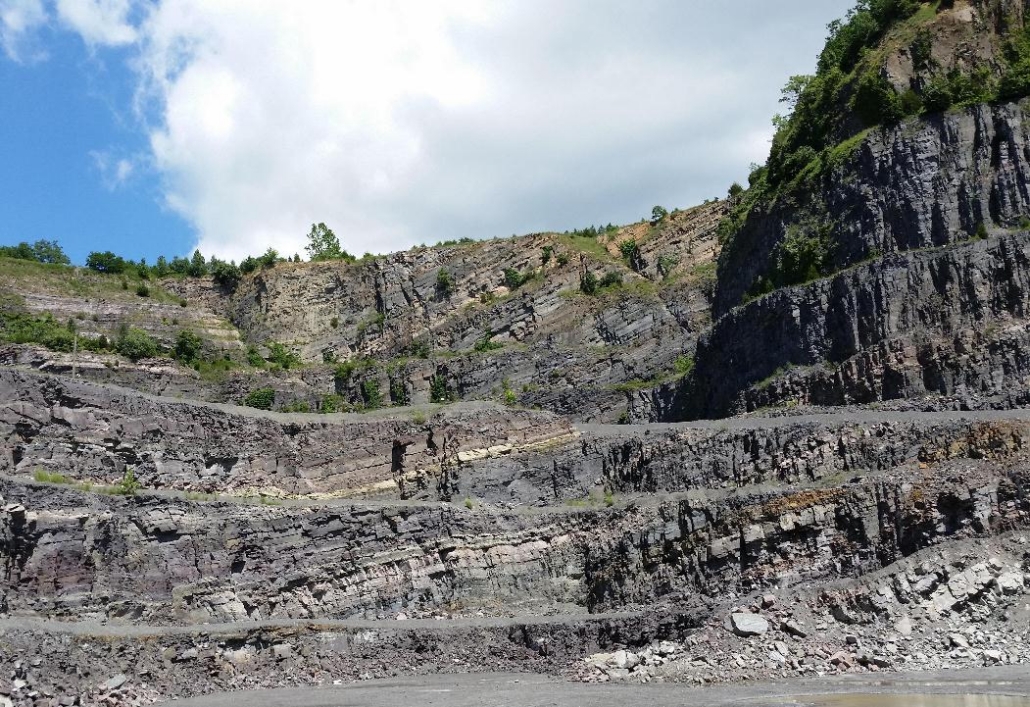
Feature photo: Luck Stone Quarry. Tilted Upwards Rock layering. Not shown is the East side folding, and a fault at the north metamorphic boundary
Photos and article by FMN Stephen Tzikas
Mining operations are inherent to the disciplines of geology and engineering. Mines can be open pit (surface), or underground. They can include minerals, coal, and other valuable products. There are opportunities as an FMN to explore quarries in the vicinity and on vacations. These can be individual visits if open to the public, or part of excursions hosted by universities, professional organizations or amateur geology/mineral clubs. The first two locations that I note here are from sites included in a Norther Virginia Community College (NVCC) 1 credit course called Triassic-Jurassic Rifting of North America: Geological Field Studies Trip to the Triassic Lowlands of Northern Virginia, which occurred on June 24, 2017. This course explored the geologic history of Mesozoic Era rift basin across the Manassas, Leesburg, and Haymarket areas. The trip was specific to the Triassic and Jurassic Periods.
At the east side of Luck Stone Diabase Quarry in Centreville, are the igneous rocks. On the west
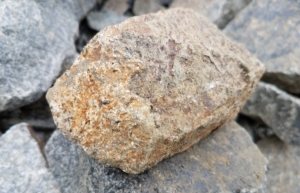
Manassas Quarry. This quarry excursion was organized by the Mineralogical Society of the District of Columbia (MSDC). Shown here is a close-up of a hand-sized rock sample containing stilbite crystals, from the Vulcan Quarry in Manassas. One might also find stellerite, calcite, prehnite, laumontite, chalcopyrite, and chalcedony in this quarry.
side of the quarry are deposited layered sedimentary rocks. On the north side, in the past, the igneous rocks rammed into the sedimentary rocks and thermally altered them, forming metamorphic rocks by contact metamorphism. The sedimentary rocks are Balls Bluff siltstone, of about 205 million years of age at the end of Triassic. The light green color layers are more coarse; while darker, purple, red, and lavender hues are finer. The igneous rock originated in a magma chamber from early rifting. They are an intrusive Jurassic diabase. The red upper color layer is iron rich. This upper most part was oxidized to the air due to its longest exposure time. The diabase is a dark pyroxene, iron augite. The light color is a plagioclase feldspar, of a high temperature igneous rock close to the Earth’s mantle. As a magma chamber cooled, there is a magmatic differentiation where the magnesium and calcium minerals settled first. As the crystals settled they evolved more light in color, and are less mafic. Later the residual melt was more felsic as it flowed through dykes.
About 205 million years ago the mantle bowed up the Earth’s crust. Rift lakes were created in the Triassic lowlands. They were filled with sediments. However, the rift basin didn’t open completely, leading to a graben central valley, and the horst mountain area. The slow cooling of the magma chamber created large crystals. The NVCC field excursion also discussed many other minerals and structures and how they were formed. The vegetation on rocks in the quarry are indicative of the minerals present, i.e., calcium loving plants.
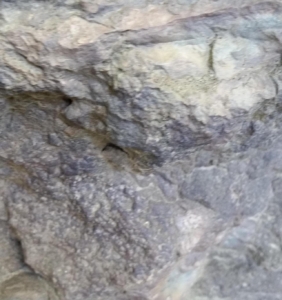
Close-up of Mount Zion Church basalt, 6×6 inch scale, at the Abandoned Haymarket Quarry. This photograph shows a porous “knob” of the basalt (lower) and a sediment infiltrated crack (upper).
At the abandoned Haymarket Quarry, Antioch Road (Silver Lake Regional Park), we observed extruded surface lava. The rock type encountered here is gray Lower Jurassic Mt. Zion Church Basalt with an inter-bedded Turkey Run Formation. In the Jurassic time some diabase broke out into iron and magnesium flood basalts, sourced from the upper mantle mafic. A vast outpouring occurred into this old river valley. This flood basalt had little silica in it, so it flowed easily (in contrast to having silica to make it resistant to flow). Gas bubbles of water/sulfur gas escaped out from a porous/ pitted vesicular texture. Sediment filled into the cracks and old basalt flow bubbles. The basalt is porous, the sediment red. This Mid-Atlantic rift event petered out. After 200 million years of weathering the tough basalt (which filled the valley) formed a topographic inversion, where the surrounding softer rock weathered away.


Great article!