Frying Pan Farm Park Pollinator Garden: Community Partnerships in Action

Kim Scudera

In 2011, Frying Pan Park did not have a pollinator garden.

By October 2012, they did, and Fairfax Master Naturalist volunteers are the reason. Here’s the story.

Frying Pan has a long history, and hosts thousands of visitors each year, many of whom are the future stewards of our environment: young children. My own children had participated for years in summer camps at Frying Pan, learning about farm life and farm animals, making butter, playing outdoors.

In July of 2012, Ashley Stanton, then service project chair for FMN, put out a call for the development of a pollinator garden, as a “thank you” to Frying Pan for hosting our annual meeting.

Sarah Mayhew, FMN Class of ‘07, pulled together a team of people from Frying Pan Park, the Fairfax chapter of the Virginia Master Naturalist program, and representatives of the Virginia Native Plant Society (Potowmack Chapter) and Earth Sangha. Without her strong leadership, this project could not have happened. Carmen Bishop, FMN ’07, served tirelessly as liaison to the park.  

A site was chosen near the historic farmhouse: the location wraps around the south and east sides of the park’s Dairy House, where a neglected garden, created by a Girl Scout troop about ten years back, was in need of a major retrofit.

With lots of input from Carmen, Sarah, Cindy Morrow, Amol Kaikini, Terrence Liercke, Alan Ford, and Lisa Bright from Earth Sangha, I designed the pollinator garden in August 2012. By September, garden preparation was complete, and plants were donated by many FMN’ers, and by VNPS Potowmack and Earth Sangha.  

Why did VNPS and Earth Sangha choose to become involved? Expanding our understanding of the value of native plants, and putting those plants into the hands of Virginia homeowners, schools, and businesses, are key elements of the missions of these two organizations. Personal connections matter, too: for example, then-VNPS Potowmack President Alan Ford is a Fairfax Master Naturalist, and these personal connections brought volunteers and donations of plants to the garden.

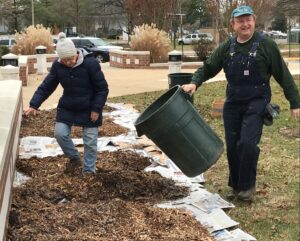
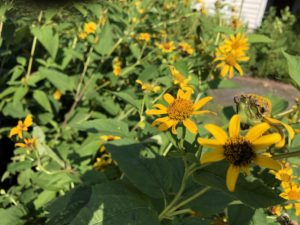
Two planting days were all it took to get the garden established. The garden includes many plants important to bees, butterflies, and other pollinating insects, including goldenrods, bee balm, and milkweed.

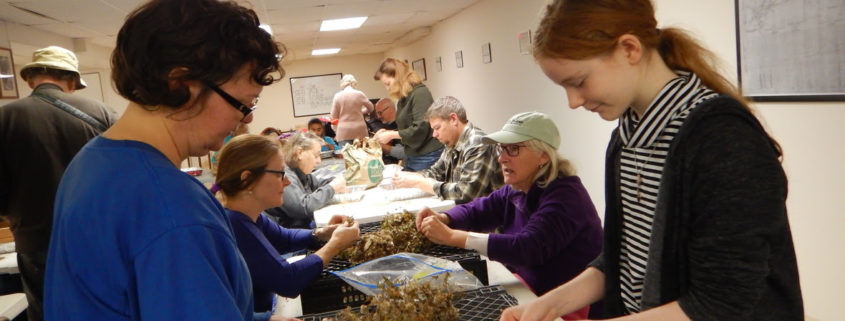
It’s one thing to get a garden started; the real challenge is keeping it going. Since 2012, I have donated over 275 hours of time caring for this garden, with help from the park (big thanks to Patrick McNamara and Marge Landis) and from FMN members. Cindy Morrow and Cynde Sears have been exceptionally helpful. 

The scope has expanded from the original Dairy House planting to maintenance and expansion of the herb garden around the Smoke House adjacent to the Dairy House.  

The herb garden was already a real magnet for pollinators of all sorts:  bees, butterflies, flies, wasps, and more. It was already home to a substantial stand of our native mountain mint. Adding more native plants with culinary uses was an obvious addition to our mission at Frying Pan, and Girl Scout Rachel O, along with her sponsor Kay Fowler, added many of these plants in 2016.

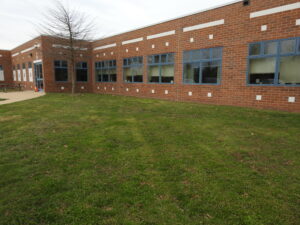
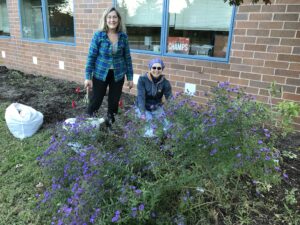
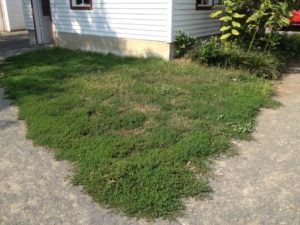
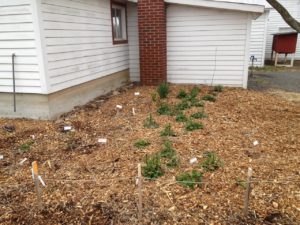
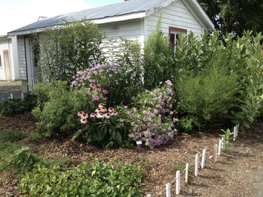
The garden has filled in well since it was first planted:

Dairy House before planting


Herb Garden before planting


Garden right after planting


Garden as of Summer 2015


Garden as of summer 2017

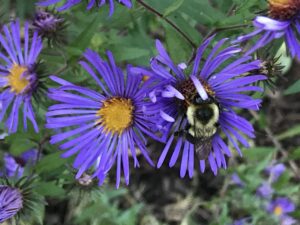
These photographs document the growth that made possible a dramatic increase in beneficial insects and their larvae in the garden: butterflies and moths (e.g., skippers, fritillaries, monarchs, cecropia moths) have been most prevalent. 

The garden has not only attracted more flying visitors—it has encouraged a considerable increase in two-legged traffic as well. The pollinator garden has hosted Brownie and Scout troops, summer campers and school groups for presentations on the value of pollinators and the plants that host them, and a steady stream of park visitors now have an interesting destination right next to the historic farmhouse, and en route to the chickens. 

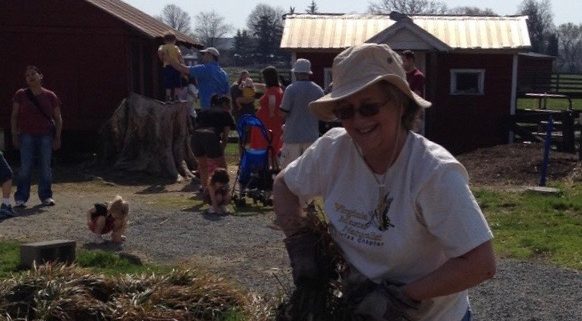
In addition, at the park’s major events, FMN has hosted information tables which reached dozens of park visitors.  These tables were staffed by Marilyn Schroeder, Joe Gorney, Valerie Lamont, Barbara Whayne, and me.

Tending the garden—which I have done since inception—is a labor of love. I plan to not only keep it going, but to make it a service project of choice for the chapter (look for S109 if you’re a member). There’s still so much to do: more edging, pruning, planting, signage, weeding, formal certification by Audubon at Home, National Wildlife Federation, Xerces… And as my mother and grandmother always said, “Many hands make light work!”

Join us!

Send us your success stories

Have you been working on a service project that has a goal?

Have you accomplished the goal or made progress toward achieving it?

Have you been working in concert with others?

Can you recount the accomplishments of your team?

Can you include measures?

Nope, you don’t need to have solved world hunger or addressed climate change all by yourself. Some successes are simply incremental steps toward outcomes that benefit the environment in Fairfax County and northern Virginia.

Every year, FMN reports stories of success to Virginia Master Naturalists. We’d like to share yours.

Whenever you are ready, please compose up to 500 words that relay (in whichever order best suits your story):

  • The name of your project and the service code
  • Its purpose, goals, and current objectives
  • Who’s working on the project–they don’t all have to be FMNers
  • What have you accomplished to date?
  • How do you measure those accomplishments beyond hours spent (e.g., if you planted a pollinator garden, what did it attract over what period of time that’s different from what used to visit that area? In addition to creatures that fly or crawl, did you attract human visitors? helpers? funding to continue? How many? How much?)
  • How much help do you need from chapter members?
  • What might we learn?
  • Why is this activity worth the investment of time?
  • How does it bring you pleasure? Would we have fun, too?

Please send the story and 2-3 photos with captions to vmnfairfax@gmail.com. A member of the FMN Communications team will be in touch within a few days, and your story will be posted to this site.

Yes, the time you spend on the story counts toward your service hours.

Questions? Again, vmnfairfax@gmail.com

Reston joins the Biophilic Cities Network with the help of Virginia Master Naturalists

Doug Britt

In his 1984 book, Biophilia, Harvard ecologist E. O. Wilson popularized the premise that people need contact with nature and that humans are inherently hard-wired for this attraction. Since then, the scientific community has reported that humans derive substantial physiological, psychological, and behavioral benefits from interacting with nature. More recently the concept of biophilia has taken root in the fields of architecture and urban planning. 

Building on the concept of biophilia, Dr. Timothy Beatley (Teresa Heinz Professor of Sustainable Communities, School of Architecture, University of Virginia) suggests that, as people across the globe become ever more urban, making life sustainable requires increasing the density and compactness of urban centers to reduce our energy use and carbon footprint.  The task of increasing urban density while simultaneously remaining in contact with nature is such a challenge that Beatley argues calls for a different approach to urban design. He suggests creatively incorporating nature into the daily lives of their residents, an activity already underway in many progressive large cities. To this end, he has spearheaded a project that attempts to link such cities together to help them share their experiences and become even healthier and more resilient communities. The resulting Biophilic Cities Network currently has 13 participating cities around the world, with many more in the application stage in an effort to join. 

In Virginia, Reston led the way into the Biophilic Cities Network 

In 2018, Reston officially became the 13th partner community, joining such biophilic cities as Singapore;  Sydney (Australia); Wellington (New Zealand); Oslo (Norway); Edmonton (Canada);  Portland; San Francisco; Austin; and Washington, DC. Dr. Beatley presented the Reston Association Board of Directors with the Biophilic Cities Network certificate on 22 March 2018. 

In 2017, Reston Association (RA) charged its Environmental Advisory Committee with the task of assessing and documenting the environmental conditions of the community to establish a baseline against which future changes could be measured. Consequently, the Committee formed a nine-member Working Group [the Reston Annual State of the Environment Report (RASER) Working Group] to undertake this task.  Among the group members were six Fairfax Chapter VMN program graduates: Doug Britt, Don Coram, Robin Duska, Linda Fuller, Lois Phemister, and Claudia Thompson-Deahl. 

The final 2017 RASER was published in July 2017. It evaluated 16 separate environmental attributes of the Reston community, concluding with a postscript arguing that Reston is a biophilic community by design and intent of its founding principles. Reston’s particular way of connecting its natural areas to its residents (through its many walking paths, trails, Nature Center, recreation areas, and education/outreach programs) maximizes such connectivity and promotes more frequent, longer duration, and more immersive interactions. The preservation of Reston’s green spaces also creates healthy viewscapes from much of the built environment. 

The RASER authors recommended to the RA Board of Directors that they consider applying for inclusion in the Biophilic Cities Network. The Board accepted the recommendation and tasked the RASER Project Director, Doug Britt, with drafting the application. Britt then contacted Dr. Beatley and explained the many ways Reston manages and monitors its natural resources and promotes connectivity between its residents and its natural areas. Dr. Beatley indicated an application from the RA would be given serious consideration.  

How the application process works

The application involves an official resolution by a city’s mayor (or a community’s primary governing body) stating that the community intends to join the Network and become a biophilic partner community. It requires documenting the key ways the community already is biophilic. It requires a statement of goals and aspirations for the future. It also requires specifying at least five different biophilic metrics that will be collected and annually reported.  

The successful applicant is expected to share best practices; participate annually in at least one webinar, workshop, or Skype/conference call; respond to requests for assistance from partner communities, if possible; host visits from delegations from other partner cities; attend where/when possible yearly or semi-yearly Biophilic Cities World Conferences; assist individuals and organizational members of the Network; and other expectations consistent with serving as a leader in the Biophilic Cities Movement.

There is a nominal $250 application processing fee, and the applicant must identify an individual to serve as the primary Biophilic Cities Network Coordinator.   

Your community may benefit as much as ours has 

The benefits include the ability to share best practices, lessons learned, and effective policies with other progressive urban communities. It identifies the community as a leader in the international biophilic movement. And it is designed to promote urban development strategies that improve public health, enhance environmental quality, and create a more resilient and productive community.

Additionally, ever more large corporations are adopting a biophilic philosophy, creating more productive and healthy work environments, and using biophilic architecture to recruit and retain employees in a competitive labor market. Being designated as a biophilic community may help attract such progressive companies, further strengthening a community’s commitment to see its residents connect with nature where they work, live, and play. 

There are certainly other communities in the Commonwealth that have biophilic attributes and a desire to protect and enhance their connectivity to nature. It would be wonderful if Virginia could become the first state to have multiple communities designated as partners in the Biophilic Cities Network.

Want to review a resource? We’d love to hear from you. Instructions for submission await your click and commitment.