Big Thank You to Founder Marilyn Schroeder

The Fairfax Chapter (FMN) has one official Cooperative Agreement (CA). A mutual agreement between FMN and Fairfax County Park Authority (FCPA) agreeing to provide mutually beneficial resources. The CA was originally signed in 2007 with a revised version of the CA was signed in 2022 by VCE Exec Dir. Micheal Cutter (for FMN) and FCPA Jai Cole, Executive Director FCPA. 

Marilyn behind an educational book table at a county fair – photo courtesy of Marilyn Schroeder

As Chair of the Fairfax Chapter’s Coordinating Committee, Marilyn Schroeder drafted the original CA when the FMN charter was established in 2007. She then represented FMN as the liaison until June 2025 when she passed the reins to another FMN volunteer. At the chapter membership meeting in June, FMN recognized Marilyn’s 18 years coordinating the meat and marginalia of FCPA activities – applying for field permits, identifying volunteer opportunities, providing FCPA trainers for FMN classes, and a myriad of other detailed responsibilities in coordination with other FMN Committees. Annually, FMN contributes more service hours towards FCPA activities than to any other single FMN chapter associate. 

Even though Marilyn will continue to volunteer in other FMN activities, it is with much gratitude that we sincerely give thanks for her many years of specific service as the liaison. She was previously honored as an FMN Trailblazer for her significant contributions in establishing the FMN chapter in 2007 – drafting initial By-laws and Operating Manual, and serving in several board positions over the years.

Katy Johnson is the new FCPA/FMN liaison.

FCPA 2025 Outstanding Volunteer Awards

As announced by FCPA at its meeting on May 28, the Fairfax County Park Authority Board approved a resolution honoring 20 individuals as 2025 Outstanding Volunteers. These peer-nominated individuals were recognized for their dedication to community and their invaluable service to the Fairfax County park system.

Jean Lockhart on duty at Hidden Oaks – photo FMN Kristina Watts

Of the twenty, two Fairfax Chapter Master Naturalist volunteers were officially recognized:
* Jean Lockhart, Hidden Oaks Nature Center, Front Desk
* Elizabeth Train, Huntley Meadows Park, Roving Naturalist/General Support
The Board stated that more than 10,000 volunteers contributed to the operation, preservation and conservation of Fairfax County parks in Fiscal Year 2025. They contributed 116,005 hours of volunteer service and their work is valued at over $3.88 million. The Park Authority could not function without the support and commitment of our volunteer force.
“Our parks meet the highest standard of beauty, safety, and accessibility in large part due to our volunteers. Their skill and passion, whether repairing trails, planting trees, or educating visitors, elevate every acre, every day,” said Park Authority Executive Director Jai Cole.

Liz Train in her finest ‘vernal pool monitor apparel’ – photo FMN Jerry Nissley

Jean, a relatively new VMN (2023), contributed hours as volunteer on duty, nature program leader, and bird counts. Liz, a VMN since 2019, is involved with just about every volunteer role possible at Huntley Meadows Park. They are both very deserving of this recognition.

The Park Authority, joined by Fairfax County Board of Supervisors honored all of its amazing volunteers with a special evening of music and celebration at the Volunteer Appreciation Night on Thursday, July 10, as part of the Government Center’s ‘Evenings on the Ellipse’ Summer Concert Series.

And The Emmy Goes To …

… FMN Kathryn Pasternak for the Outdoors Maryland segment titled “Ghost Rivers”. Ghost Rivers tells the story of Sumwalt Run, a stream that once flowed through Baltimore’s Remington neighborhood. In the early 20th century it was buried in a brick and concrete culvert up to 40 feet below street level. The same fate as natural streams in cities throughout the world, including a network of streams in Arlington, Alexandria, and Washington, D.C. – But I digress.

MPT’s David Wainwright (sound) and Brian Windle (camera) filming Ghost Rivers tour led by artist Bruce Willen – photo Kathryn Pasternak

Artist Bruce Willen memorialized Sumwalt Run by tracing its path through the neighborhood, marking it with a sinuous blue line and adding educational markers that tell the environmental, cultural and historical story of the stream along the path it takes all the way to the Jones Falls, and then out to the Chesapeake Bay.  Kathryn and the team worked with Bruce filming the final stages of the Ghost Rivers public art installation, and accompanied him on a walking tour he gives with local residents. They also filmed the Baltimore Department of Public Works inspecting the interior of the Sumwalt Run culvert using a crawler camera, and then doing water testing at the outflow of Sumwalt Run at Jones Falls.

DPW inspecting Sumwalt Run culverts – photo Bruce Willen

The Outdoors Maryland Episode received the Emmy Award and like all their episodes, it has three stories. The 3 stories stitched together in Episode 3603 each have a different theme about water. Series Producer Stefanie Robey describes it this way: It was a Bay/water themed episode, with stories about submerged aquatic vegetation restoration work, open-water swimming, and the Ghost Rivers project.

Brian Windle films Bruce Willen during installation of Ghost Rivers Site #2, Wyman Park Dell at 29th Street, Baltimore. – photo Kathryn Pasternak

Kathryn thinks part of what helped them win was that the episode told stories about water from three totally different perspectives — a more science/restoration focused piece, a recreation focused piece, and then a historical/cultural/arts focused piece with Ghost Rivers. Kathryn’s segment starts at the 9:45 mark of the episode and runs to the 18 minute mark. But the entire episode is interesting.

Eight months work for eight minutes of video. That’s tenacity. The episode won for Science/Environment Long Form.  (Watch here: Outdoors Maryland, scroll down to Episode 3603).

Sumwalt Run expelling into Jones Falls – photo Kathryn Pasternak

Kathryn (Pasternak Media) became an FMN in 2021 but she is also a veteran of wildlife, conservation, and cultural films; and recipient of two National Emmy Awards for ‘Best Science and Nature Program’. She spent 15+ years at National Geographic Television working on high-end programs for international distribution. Since 2007, she’s been producing media independently both as a freelancer and small business owner.

Acknowledgments:
Outdoors Maryland: Series Producer Stefanie Robey principally, and Executive Producer, Frank Batavick.
Photos: FMN Kathryn Pasternak and Bruce Willen

Stream Monitoring Citizen Science & Training Opportunities, August Dates Available

Photo: By FMN J. Quinn, Stream monitoring

Are you interested in obtaining a Virginia Save Our Streams Stream Monitoring certification? This certification is not required for the workshops, but it allows you to monitor your own site if you wish. The certification consists of three parts – watching online webinars, passing an online macroinvertebrate ID exam, and taking an in-person field protocols exam.


Difficult Run Stream Monitoring Workshop

When: Saturday, August 9, 9:00am-12:00pm
Where: Difficult Run Stream Valley Park, Great Falls

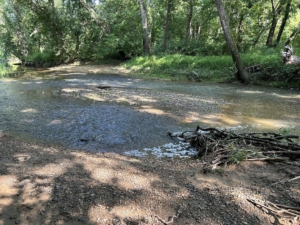
This stream site in Great Falls is a short walk through the woods to a river with wide, sandy banks. These trails are very popular with hikers and monitors often get high water quality scores at this site. Reaching this site requires walking on an established trail. Learn more and register for this workshop and others here.


TBD Stream Monitoring Workshop

When: Sunday, August 12, 9:00am-12:00pm
Where: TBD

Monitors are holding this space as a rain date for another workshop, or perhaps to explore a new stream to add to their monitoring roster. Although they don’t have any more details yet, they wanted to share this placeholder with you, with more info to follow in the August newsletter.


TBD Stream Monitoring Workshop

When: Thursday, August 17, 9:00am-12:00pm
Where: TBD

Monitors are holding this space as a rain date for another workshop, or perhaps to explore a new stream to add to their monitoring roster. Although they don’t have any more details yet, they wanted to share this placeholder with you, with more info to follow in the August newsletter.


The NVSWCD is very excited to contribute their stream data to state and national datasets. If you’d like to see data from all the NVSWCD regional stream monitoring team’s active sites, you can find the organization on the Clean Water Hub.

Beech Leaf Disease (BLD)

Photo: Courtesy of FCPA, Beech Leaf Disease observed in Burke Lake Park

The following Information comes from the Urban Forest Management Division Annual Report Fiscal Year 2024, Released April 2025

Beech Leaf Disease (BLD)

What is it?
BLD, a relatively new disease of native American beech as well as other
Fagus/beech species, is caused by a foliar-feeding nematode (a
microscopic roundworm). The nematodes enter the tree’s leaf buds in
the fall where they overwinter, multiply, and feed on newly forming
leaf tissues. The nematodes further multiply and spread throughout
the tree from year to year until leaf buds no longer produce leaves.
As healthy foliage decreases, the tree’s energy, nutrient, and water
uptake decreases, and the tree eventually dies.
Why is it a problem?
Beech trees are critical to the native forest ecosystem, providing
food for a wide variety of wildlife, and bearing nutrient-rich fruit with
seeds that last through the winter and serve as a food source when
other plants have long stopped producing. There are approximately 4.3
million beech trees in Fairfax County, making them tied with red maple
for the County’s most common tree species. BLD, nearly 100% fatal,
is spreading rapidly; and there is no known safe treatment option for
forested environments.
What is being done?
County staff achieved the following results and milestones in FY 2024:
 Mapped 6 infestations totaling 60 acres at regional and County parks (previously 13 acres in FY 2023).
 Established 4 monitoring plots in beech stands confirmed to have, or at high risk of developing, BLD.
 Participated in a comprehensive U.S. Department of Agriculture (USDA) Forest Service study spanning the full geographic reach of
both BLD and beech bark disease.
 Hosted a webinar—“Unraveling the Mystery”—in partnership with Virginia Cooperative Extension (VCE) to raise awareness.
 Contributed BLD samples for a regional nematode DNA study out of the University of Connecticut.
How YOU can help!
– First, learn to IDENTIFY early symptoms of the disease, infected leaves, and other diseases that can appear like BLD.
– REPORT sightings on iNaturalist, an easy-to-use app that shares information with community scientists.
– And finally, PRACTICE good tree care such as proper mulching and watering during droughts; and be considerate and responsible when it
comes to selecting soil treatments and other landscaping services.

This report is in PDF format which allows you to search for other pest like the hemlock woolly adelgid, and the spotted lanternfly..


Pollinator Pathways: Connecting your yard to the bigger picture

Photo: Plant NOVA Natives

Article by Eileen Ellsworth

Imagine the world as it once was. Verdant forests, buzzing meadows, and numerous other natural areas were immense, whole, and pulsing with life. Over time, human activity emerged and carved the natural world into disconnected, even isolated parts. Ecologists refer to this process as habitat fragmentation. You can see it in urban settings where green parks are biological islands surrounded by buildings and concrete roads. You can see it in rural settings where agriculture simplifies ecosystems and amplifies the populations of only certain insects to the detriment of others. You can see it in suburban settings where developments destroy natural habitats and where landscapes are “replaced” with all non-native species.

Large and mostly undisturbed ecosystems can still be found, of course, especially in our beloved national parks and forests. But even they are distant from each other, understaffed, and too small in total acreage to sustain the biodiversity of the continent. Any solution to the problem of habitat fragmentation and the resulting loss of biodiversity, therefore, must be found right here among the throng of human life – where we live, work and play.

Is it possible to reconnect isolated fragments in our urban, suburban, and rural settings to benefit pollinators and the creatures that depend upon them? That was the question that sparked the “pollinator pathway” concept in 2007 by Sarah Bergmann, an artist living in Seattle. As part of a social and ecological project, she envisioned and described a network of native gardens that could create a “pathway” to support pollinators. This core idea led to the creation of a nonprofit – Pollinator Pathway – by Donna Merrill, a conservationist from Wilton, Connecticut, in 2017. Since then, the group has helped inspire and launch a national movement.

The idea is a powerful one. Anybody can take part, even at a novice level. There are very few barriers to participation. If all you have is one native tree or a  small pollinator garden – preferably one with some native plants – it’s a start, and you can build from there.

The main goal of a pollinator pathway is to reinstate connectivity between several small but healthy habitats. A single native tree can support bees and other pollinators as much if not more than a flower garden. Building a pollinator pathway on your street, for example, may include adding a new native tree or two, or creating new healthy gardens on communal grounds or private property as “stepping stones” along the way. It may include the expansion of existing native plant areas. Removal of invasives that disrupt the pathway will certainly be part of the plan, along with pledges to avoid all broadcast pesticides including mosquito and tick sprays. Only unpoisoned ecosystems can be included in the work.

Many communities across America are already building pollinator pathways and proving the concept. You can recruit participants on your own, or have fun working with like-minded people to muster engagement. Hold a kick-off meeting to build some early momentum. Don’t over plan. Take some early action, starting with 1 or 2 easy planting projects, then see where it takes you.

On a new webpage just launched by Plant NOVA Natives you will find some handy tools to help you build a pollinator pathway in your neighborhood or community. They include:

  • A tip sheet for pollinator pathway organizers
  • Instructions for ordering medallion signs that will be delivered to your house from Plant NOVA Natives for you and your participants. If you are in Northern Virginia, we will have the sign company mail you the first five for free.
  • Ideas for how to pitch the idea to the folks you want to engage
  • Pollinator Pathway handouts to leave with your neighbor.

Join the movement! Let’s work with our neighbors and friends to connect the fragments, rebuild some beneficial habitats, and heal the everyday ecosystems that surround us. Their resilience is astonishing. New life, activity, and hope will certainly emerge, along with a new joy in being part of something much bigger than our own backyards.

Hiss-teria Averted: Staying Safe Around Snakes, Webinar July 16th

Photo: NVCT

Wednesday, July 16, 2025
12 PM – 1 PM
Zoom link provided upon registration

Snakes often get a bad rap, but we share this land with them and they have important roles in their respective environments. In this webinar, learn how to properly identify, handle and avoid unpleasant interactions with native snakes of Virginia. Don’t worry, this session is completely virtual, so you won’t have to test your limits too much!

Brought to you by Northern Virginia Conservation Trust’s Nearby Nature Network. Presented by Bill Crisp of K2C Wildlife Encounters.

Celebrating a FMN 2025 Spring Basic Training Graduates

Photo: FMN Mary Ann Bush, FMN Spring Grads – June162025

On Monday June 16, we proudly celebrated the graduation of a passionate and dedicated group of students from our Master Naturalist Basic training program. What began as a shared curiosity about the natural world has transformed into a community of informed and enthusiastic stewards of our local environment.

Over the past several months, these individuals immersed themselves in both classroom learning, and field trips which facilitated hands-on, experiential learning opportunities outside of the classroom. They learned not only about native ecosystems and species, but also how to be a part of natural resource conservation in the community

Graduation is more than a milestone—it’s a beginning. These new graduates are now equipped and eager to take on a wide range of volunteer opportunities: leading nature hikes, restoring habitats, monitoring wildlife, educating the public, and much more. Each graduate brings a unique voice and skillset, and together they form a force for good in our natural communities.

To our newest graduates, we can’t wait to see where your curiosity, compassion, and commitment take you next!

Here are the 2025 Spring FMN Basic Training Graduates:
Alsegaf, Kathy
Baucom, Celeste
Borghi, Aurora
Bretz, Kevin
Colby, Charles
Curley, Christina
De Nardi, Mia
Edwards, Eren
Grass, Nancy
Gravatt, Peyton
Newberry, Tucker
Racine, “Anna Virginia “”Hope”””
Racine, James
Smyth, Trish
Zavala, Andy
Malcolm Macniel
Elliff, Rachel
Conway Dodge
A special acknowledgement goes out to three students who have achieved their initial certification by their graduation date:
Mia De Nardi, Aurora Borghi and Andy Zavala

Congratulations, and welcome to a lifelong journey of learning, service, and connection to the natural world!


Mason Neck Kayak Adventures – 2025

Announcing the ‘FMN only’ summer Kayak Tours at Mason Neck State Park!

June Evening: Saturday, 6/28/25, 6:00-8:00 PM
July Evening: Friday, 7/25/25, 6:00-8:00 PM
August Morning: Sunday, 8/24/25, 9:00-11:00 AM
September Afternoon: Sunday, 9/07/25, 1:00-3:00 PM

The 2 hour tours guide paddlers out into Belmont Bay and up Kane’s Creek into the heart of the park that can only be seen via the water. Explore the plants and animals found along the way; discuss the importance of wetlands; learn the history of Manson Neck peninsula; and enjoy the beauty and serenity of floating among the lilly pads, surrounded by forest.

*Guests please arrive 30 minutes prior to start time to gear up*

These are FMN only tours. Limit 10 per tour.
Registration is free and must be done via BI calendar.
Once the tour fills, registration auto-locks and it disappears from the Opportunities Calendar but remains on the Opportunities List.

All guests are required to use park provided kayaks and paddles.
PFDs are provided but you may bring your own. Personal PFDs must be Coast Guard approved/labeled Type III or better.

Appropriate clothing for the weather, activity level, and closed-toe shoes are encouraged. Below is a park provided link to a guide for recommended kayak-clothing. https://www.rei.com/learn/expert-advice/kayaking-what-to-wear.html

To register:
1. Login to BI and click on your ‘Opportunities’ tab.
2. Select ‘Opportunity Calendar’ from the pull-down menu.
3. Find event in the displayed calendar; Click it to see event details.
4. To sign up, Click the ‘Sign Up’ box in the lower right. This automatically signs you up and puts the event on your personal calendar.
5. To claim 2.5 CE hours: please use All Continuing Education -> FMN All other Chapter Training, as the Approved Org.

Mason Neck Kayak – photo JaneEllen Saums

A thought provoking prose to encourage this tour is Charles Dickens’ luminous writing about the beauty of the natural world – “The freshness of the day, the singing of the birds, the beauty of the waving grass, the deep green leaves, the wild flowers, and the thousand exquisite scents and sounds that floated in the air— deep joys to most of us, but even more so to those whose life is in a crowd or who live solitarily in great cities as in the bucket of a human well—sunk into their breasts and made them very glad.”

As you push off from the shore, inhale deeply, relax, immerse yourself in the natural world, and become “very glad”.

Katy Johnson – The New FMN Liaison to FCPA

As many readers already know, FMN has maintained a signed Cooperative Agreement (CA) with Fairfax County Park Authority (FCPA) since chapter inception in 2007. Annually, FMN contributes more collective volunteer hours towards FCPA Activity Codes than any other single partner organization.
In turn, FCPA provides FMN with course instructors, meeting facilities, volunteer opportunities, and access to parks for field trips and CE hikes.
In 2024, FMN reported over 5300 volunteer hours at 12 individual FCPA sites.

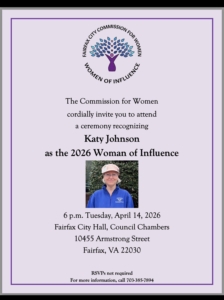
The CA identifies liaison roles and responsibilities for both FCPA and FMN. Together the liaisons coordinate activities, acquire field trip permits, identify opportunities, and maintain open communications between the orgs. Currently, Tammy Schwab is the FCPA liaison and Katy Johnson is the newly designated FMN liaison. Katy takes over from Marilyn Schroeder who held the FMN role since 2007, when she helped establish the initial CA.

FMN Katy Johnson with a trillium – photo Katy Johnson

Katy graduated FMN training in 2021. Since then she has contributed over 600 service hours and is also the POC for FMN activities in Fairfax City. She is very familiar with the functional liaison responsibilities defined in the CA by virtue of her similar role in another local organization, Northern Virginia Mineral Club. Katy joined NVMC and FMN because she believes in their missions – to educate and spread an understanding of the importance of natural resources in our everyday lives.

Going forward please direct questions regarding FCPA opportunities to Katy

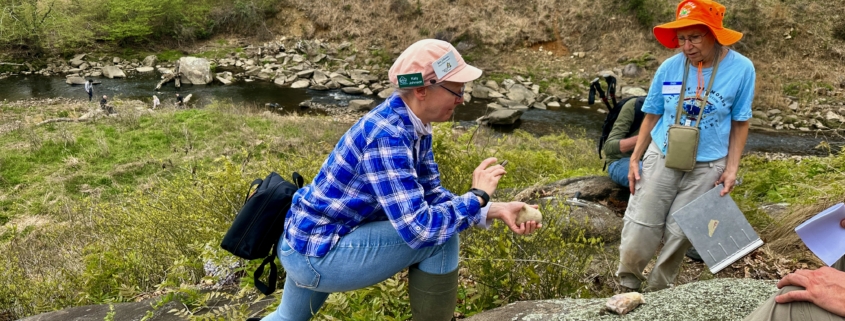
FMN Katy Johnson rockhounding – photo Katy Johnson

(katynor@gmail.com). FMN has 10 individually defined Activity Codes for FCPA. We look forward to continuing our long time association with Fairfax County Parks. Thank you Katy!

FYI – Additional Chapter Partners:
The formal CA with FCPA is the only signed agreement our chapter maintains. We do, however, have other Chapter Partners and we strive to identify points of contact for each of them in their corresponding BI Activity Code descriptions.
For example, FMN service hours for Fairfax Tree Stewards may be recorded using Activity Code S405. The FMN POC for FTS is found in the S405 Activity Code description in BI, along with additional details so you may ask questions of someone directly involved with that organization.

The FMN web site lists several chapter partners and links to their sites for general information. FMN POCs and specific FMN Activity details will normally only be found in the BI Activity Code Description, as described above for S405.

Of course if all else fails, please direct activity code catalog and CE questions to the Hours/CE co-chairs and we will work with you to clear the fog.
Hours/CE email – FMNcontinuingED@gmail.com

Acknowledgements:

Cover photo – two handsome KATYdids liaising on a hibiscus. Photo Jerry Nissley