Friends of Dyke Marsh Ask Your Help To Tackle Invasive Plants, Various Dates: August Through December

Photo: FMN Margaret Fisher, Trees being engulfed by invasive plants

Help protect native plants by pulling and clipping invasive plants. You will receive training to identify the five or so target plants. FODM kindly ask that you not bring pets. Invasive plants can threaten and outcompete native plants.

Bring gloves, hand clippers and water. Instructions, plant examples and trash bags will be supplied. Wear long sleeves and pants and sun protection. Some tools will be available to share. The event will be cancelled in the event of lightning or severe storms.

Meet at the Haul Road trail entrance bench. If it is raining one hour before a scheduled session, we will cancel it.

Haul Road Trail directions and parking:

GPS coordinates: 38.777739, -77.050540 South of Alexandria off the GW Memorial Parkway at the sign for Dyke Marsh Nature Preserve and Belle Haven Marina, turn east onto the road toward the Potomac River. Take the first left and park in the Belle Haven Park lot. Walk back to the marina road and turn east, toward the river. Walk 30 yards. On your right is a Dyke Marsh sign and the entrance to the Haul Road trail.

Click here for additional information and sign-up link.

Date(s):

  • August 16, 9 a.m. – 11 a.m.
  • August 30, 9 a.m. – 11 a.m.
  • September 13, 10 a.m. – 12 p.m.
  • September 27, 10 a.m. – 12 p.m.
  • October 11, 10 a.m. – 12 p.m.
  • October 25, 10 a.m. – 12 p.m.
  • November 8, 10 a.m. – 12 p.m.
  • November 22, 10 a.m. – 12 p.m.
  • December 6, 10 a.m. – 12 p.m.
  • December 20, 10 a.m. – 12 p.m.

Biodiversity or Mosquito Fogging: You can’t have both

Article and photo by Plant NOVA Natives

Ah, the mosquito. It plagues our summers and can ruin our outdoor fun. Is anyone a fan? If so, consider the Asian tiger mosquito, which has no regard for personal space or time. If you happen to have it in your yard, it bites everyone, morning, noon, and night. In winter we long for warm weather, but when it finally arrives, in some neighborhoods we are indoor prisoners. Understandably we want to rid ourselves of this awful pest.

Some of our neighbors turn to commercial-grade mosquito fogging, persuaded by marketing claims that the product is both effective and “safe”. But a closer examination of these claims reveals an ineffective process that is devastating for native bees, butterflies, moths, and a plethora of other beneficial insects we work so hard to attract with native plants.

How effective is mosquito spraying? How effective can it be when the chemicals in the product only target adult mosquitos and only those adults within direct range of the fog? By some estimates, no more than 20-30% of adult mosquitos are killed in one treatment. Meanwhile all mosquito larvae, which are laid and hatched in standing water, are unaffected. They continue to grow and emerge as if nothing harmful has happened in their environment. As a result, the adult population of mosquitos is quickly replenished while nearly every other insect the fog touches is indiscriminately killed.

Mosquito spray producers point to EPA statements that the chemicals are safe for bees when used according to label instructions. But there are severe limitations to the EPA’s testing method. The agency only tests on honeybees and only measures the chemical toxicity resulting from surface exposure, not oral ingestion.

This is highly problematic. Honeybees are only one species of bees and are non-native to boot. That leaves 400 species of native bees in Virginia, along with all butterflies, moths, dragonflies, ladybugs, fireflies, and numerous other beneficial insects that are not tested. Those insects have entirely different life cycles, foraging methods, and ways of protecting and feeding their larvae which render them tragically vulnerable. It is a complete folly to extrapolate EPA’s honeybee-focused test results to any other insect species.

Consider this: One spray of mosquito fog leaves a persistent residue on the surface of everything it touches. Repeating the applications every 10-30 days, as many commercial services recommend, just compounds the problem. The EPA says it considers how long the chemical residue persists in the environment and its effect on honeybee colonies. However, honeybees can forage up to 5 miles away from their hives if necessary, far away from the fogged area and the residue. Our native mason bees, on the other hand, forage no further than 300 feet from their nests. They are wholly dependent on the health of their immediate surroundings to eat and reproduce. Adults have no way to avoid exposure.

Neither do their larvae. Leaf cutter bees and mason bees, for example, produce dough balls that are left in hollow stems for their developing larvae to eat. The balls are composed of pollen and nectar from the flowers in their immediate foraging range. As the larvae hatch and eat the dough balls, they ingest concentrated levels of the pesticides and die. For our native bees, there is no honeybee equivalent of the hive to ensure their survival. They live their lives alone. As their larvae die, all subsequent lines of offspring from affected individuals are gone for good.

Fortunately, as research has advanced on fogging, so too has the thinking on several alternative, inexpensive methods of control. Here are some very safe and effective suggestions, especially when used together as a suite of tools.

Source Removal. The most effective method of mosquito control by far is “source removal,” or emptying/eliminating all sources of standing water on your property. This practice kills mosquito larvae before they become biting adults. Regularly inspect your property for containers or areas that hold water, then remove or empty them. Remember to inspect flowerpots, buckets, or any other feature or item that can hold water. Change the water frequently in places where you want it – like birdbaths – so the larvae have no time to grow and emerge. Maintain your gutters and downspouts so the water flows. Keep your swimming pools and hot tubs clean and properly chlorinated.

Mosquito Buckets: This is a favored method of control by Doug Tallamy, an entomologist at the University of Delaware and national proponent of supporting biodiversity in our own backyards. He recommends filling a five-gallon bucket of water, placing it in the sun, then adding a handful of hay, grass, straw, or leaf litter to decay and attract egg-filled female mosquitos. After they lay their eggs, add a mosquito dunk tablet you can purchase at any hardware store, garden center, or home improvement retailer. It contains a bacteria that kills several species of fly larvae, including mosquitoes. A more detailed explanation of the process – and photos of lovely painted buckets –  can be found on Dr. Tallamy’s Homegrown National Park website.

Ovitraps: Ovitraps, which are available from the same stores as mosquito dunks as well as on Etsy, use scent to attract adult egg-laying females, trap them, and kill both the adults and the larvae they produce.   

Water Wrigglers: Water Wrigglers are devices you can purchase to keep water moving in birdbaths. They were designed to attract birds to the sight and sound of running water but are also highly effective in stopping female mosquitos from laying eggs.

Deck Fans: Mosquitos are weak fliers. Turn on a fan while you enjoy your deck and make it harder for mosquitos to reach you.

Personal Protection: When spending time outdoors, consider wearing long pants, sleeves, and a hat, and spraying your clothing and skin with insect repellant. Personal precautions such as these can prevent mosquito bites entirely.

Community Efforts: Mosquito control is very successful when several neighbors in a larger community participate. Talk to your neighbors about source removal, ovitraps, fans, and water wigglers. Show them your homemade mosquito bucket and encourage them to do the same – or bring them one as a gift! Some studies tout this approach above all others, suggesting that mosquito populations can be reduced by 85% when the whole street or block works together. One way to approach your neighbors is by inviting them to join a Pollinator Pathway and giving them a nifty little sign to display which will encourage other neighbors to rethink their mosquito-spraying contracts.

We all enjoy our yards and our pollinator gardens, and we understand how including native plants promotes biodiversity. But along with joy comes responsibility. If we don’t protect the very life we’ve helped emerge, no one will. We can have improved biodiversity, or we can have pesticides. They do not co-exist.


Winter Nature Art Classes at Hidden Oaks, October 10th and November 15th

Drawing by Elaine Sevy


Improve your naturalist observation skills and add excitement to your nature journals!

Naturalist Nayeli Arellano will present nature drawing and journaling classes at Hidden Oaks Nature Center, 7701 Royce Street, Annandale.

To sign up: Call 703-222-4664 weekdays 9am- 4pm or

Log into Parktakes by using:  http://www.fairfaxcounty.gov/parks/parktakes

Registration for Fall classes begins on August 29

Drawing Songbirds (Adults 16 and up)

Sunday, Oct 10, 2025
3-5 pm

Fee: $20.00

Get to know our local songbirds through field sketches and studies. Includes a presentation on natural history, drawing tips, and a short bird hike.

Nature Journaling – Reciprocity in Nature (adults age 16 and up)

Saturday, Nov. 15, 2025
9:30-11:30am

Fee: $20.00

Explore your relationship with the natural world through writing and sketching. In this reflective class, we’ll use journaling prompts and simple drawing exercises to consider the ways we give to and receive from nature. No art or writing experience needed — just curiosity and a willingness to slow down and observe.

******

FOR FMN CE Credit: These classes are approved FMN CE.  Record hours in Better Impact under Continuing Education > All Continuing Education.  For Approved CE Organization, choose Fairfax County Park Authority training.  In Description, include the name of the class.

Difficult Run Stream Valley Park Habitat Restoration! – Oakton, August 17th

Image: Courtesy of the Fairfax County Park Authority

August 17th,2025
10:00 am – 12:00 pm

Difficult Run Stream Valley Park
Oakton, VA 22124

Contact Name: Sara Holtz
Email: sh12sh34@gmail.com
Primary Phone: 703-901-0603

CLICK HERE FOR REGISTRATION AND OTHER DETAILS.

Did you know that invasive plants are a huge threat to local wildlife, including migrating birds? Help out these creatures by volunteering to remove invasive plants and restore habitat!

Through removal of invasive plants, you’ll help restore natural habitats for wildlife in Fairfax County, while spending time outdoors & meeting new people. All ages are welcome. Meet at the trailhead near 3000 Miller Heights Rd, Oakton.

Additional Information

Duties:
Volunteers will manually remove invasive plants and plant native species. Thank you for your interest in volunteering with the Park Authority. In working to ensure everyone’s safety, the Park Authority follows current CDC guidelines. If you are not feeling well, please stay home!

Qualifications:
No prior experience necessary, a short training and introduction will be provided at the beginning of every opportunity. Registration for IMA workdays must be submitted by 3pm on the Friday prior to a weekend workday and by 12pm on the day prior to a weekday workday. Volunteers 11 years old and under must be accompanied by an adult.

Purpose:
To restore parkland through the removal of invasive plants and planting of native species.

Benefits:
Volunteers will immediately be able to see how their efforts have had a positive impact on parkland. Volunteers will make parks they volunteer at more aesthetically pleasing and improve the quality of habitat for local wildlife.

The Grist Mill at Colvin Run Mill Park

Feature photo: Fairfax County Park Authority

Article and other photos by FMN Stephen Tzikas

Just off Route 7 in Great Falls, Virginia, is a rare working grist mill from the early 19th century. The Colvin Run Mill campus is part of the Fairfax County Park Authority, and is an opportunity to see nature and engineering working together.  Grist mills offer the opportunity to observe engineering principles related to powder technology in a park setting.  In 2002, my first visit to a mill, known as Evins Mill, coincided with a chemical engineering course on powder processing I attended in Tennessee. The instructor wrote the Size Reduction and Size

Close up of the water wheel

Enlargement chapter in Perry’s Chemical Engineering Handbook. The simple grist mills of the past represented the beginnings of powder technology engineering. Powders are used in a variety of industries including the pharmaceutical, consumer products, food and industrial chemical sectors.  The handling of powders requires a knowledge of properties related to particle size, moisture sorption, surface area, surface chemistry, hardness, density, and flowability. Operations include segregation and powder sampling, as well as key unit operations of mixing, grinding, agglomeration, classification, fluidization, drying and compaction, as well as solids transport between unit operations.

The grinding unit

The Colvin Run Mill is powered by a 20-foot waterwheel. The use of elevators, moving belts, and Archimedean screw conveyors made the milling operation more efficient and profitable, as an early example of mass production. The wheel’s axle transmits power from the turning waterwheel into the mill. The greater face gear attached to the axle in the mill basement turns the wood gears that operate the grinding stones, grain elevators, and sifting machinery. The waterwheel produces up to 26 horsepower, turning (outside) at a rate of 10 rpm, resulting in a top grindstone rate of 100 rpm.  Premium burr stones were imported from France to grind the grain.

The tour of the mill’s four floors includes the main grinding floor, the

The racker unit, which cools the powder and prevents its caking

basement, the gear pit, and other processing units. The mill offers the ability to load, convey, sift, grind, separate and dry grain into various desired grades. Each of the four floors of the building served a specific function in turning the grain into flour or cornmeal.

The engineering processes seen at the Colvin Run Mill tour will include:

  • Gears: Falling water moves the water wheel and all gears throughout the mill’s operation. The speed of the water wheel can be adjusted, thereby controlling the speed of the
  • Lever: A beam scale weighs grain from farms. A receiving hopper gathers the grain.
  • Pulley: Pulleys move grain upstairs for cleaning. The grain flows down a chute where it is captured by cups, and transported to the top floor and emptied into another chute.
  • Screens: Screens remove dirt, seeds, sticks, straw, chaff, fungus, smut, broken grains, and bugs. Shaking shifts the grain.  There are different size mesh screens for final processing of the milled grain.  They range in size from super fine to coarse.
  • Inclined plane: A inclined plane sends the cleaned grain to the grinding operation.
  • Grinding: Special French millstones mill the wheat. A screw lifts the mill stone into place for grinding. Wedges line the millstone where they grind the grain. These special French millstones are fossils called burr stones. They rip and shred the grain.  Shafts in the stones move the grain to the next operation.
  • Raking:  Since crushing the wheat generates heat and warms the grain powder, rakes (known as hopper boys) help cool the wheat and prevent caking and clumping


Big Thank You to Founder Marilyn Schroeder

The Fairfax Chapter (FMN) has one official Cooperative Agreement (CA). A mutual agreement between FMN and Fairfax County Park Authority (FCPA) agreeing to provide mutually beneficial resources. The CA was originally signed in 2007 with a revised version of the CA was signed in 2022 by VCE Exec Dir. Micheal Cutter (for FMN) and FCPA Jai Cole, Executive Director FCPA. 

Marilyn behind an educational book table at a county fair – photo courtesy of Marilyn Schroeder

As Chair of the Fairfax Chapter’s Coordinating Committee, Marilyn Schroeder drafted the original CA when the FMN charter was established in 2007. She then represented FMN as the liaison until June 2025 when she passed the reins to another FMN volunteer. At the chapter membership meeting in June, FMN recognized Marilyn’s 18 years coordinating the meat and marginalia of FCPA activities – applying for field permits, identifying volunteer opportunities, providing FCPA trainers for FMN classes, and a myriad of other detailed responsibilities in coordination with other FMN Committees. Annually, FMN contributes more service hours towards FCPA activities than to any other single FMN chapter associate. 

Even though Marilyn will continue to volunteer in other FMN activities, it is with much gratitude that we sincerely give thanks for her many years of specific service as the liaison. She was previously honored as an FMN Trailblazer for her significant contributions in establishing the FMN chapter in 2007 – drafting initial By-laws and Operating Manual, and serving in several board positions over the years.

Katy Johnson is the new FCPA/FMN liaison.

FCPA 2025 Outstanding Volunteer Awards

As announced by FCPA at its meeting on May 28, the Fairfax County Park Authority Board approved a resolution honoring 20 individuals as 2025 Outstanding Volunteers. These peer-nominated individuals were recognized for their dedication to community and their invaluable service to the Fairfax County park system.

Jean Lockhart on duty at Hidden Oaks – photo FMN Kristina Watts

Of the twenty, two Fairfax Chapter Master Naturalist volunteers were officially recognized:
* Jean Lockhart, Hidden Oaks Nature Center, Front Desk
* Elizabeth Train, Huntley Meadows Park, Roving Naturalist/General Support
The Board stated that more than 10,000 volunteers contributed to the operation, preservation and conservation of Fairfax County parks in Fiscal Year 2025. They contributed 116,005 hours of volunteer service and their work is valued at over $3.88 million. The Park Authority could not function without the support and commitment of our volunteer force.
“Our parks meet the highest standard of beauty, safety, and accessibility in large part due to our volunteers. Their skill and passion, whether repairing trails, planting trees, or educating visitors, elevate every acre, every day,” said Park Authority Executive Director Jai Cole.

Liz Train in her finest ‘vernal pool monitor apparel’ – photo FMN Jerry Nissley

Jean, a relatively new VMN (2023), contributed hours as volunteer on duty, nature program leader, and bird counts. Liz, a VMN since 2019, is involved with just about every volunteer role possible at Huntley Meadows Park. They are both very deserving of this recognition.

The Park Authority, joined by Fairfax County Board of Supervisors honored all of its amazing volunteers with a special evening of music and celebration at the Volunteer Appreciation Night on Thursday, July 10, as part of the Government Center’s ‘Evenings on the Ellipse’ Summer Concert Series.

And The Emmy Goes To …

… FMN Kathryn Pasternak for the Outdoors Maryland segment titled “Ghost Rivers”. Ghost Rivers tells the story of Sumwalt Run, a stream that once flowed through Baltimore’s Remington neighborhood. In the early 20th century it was buried in a brick and concrete culvert up to 40 feet below street level. The same fate as natural streams in cities throughout the world, including a network of streams in Arlington, Alexandria, and Washington, D.C. – But I digress.

MPT’s David Wainwright (sound) and Brian Windle (camera) filming Ghost Rivers tour led by artist Bruce Willen – photo Kathryn Pasternak

Artist Bruce Willen memorialized Sumwalt Run by tracing its path through the neighborhood, marking it with a sinuous blue line and adding educational markers that tell the environmental, cultural and historical story of the stream along the path it takes all the way to the Jones Falls, and then out to the Chesapeake Bay.  Kathryn and the team worked with Bruce filming the final stages of the Ghost Rivers public art installation, and accompanied him on a walking tour he gives with local residents. They also filmed the Baltimore Department of Public Works inspecting the interior of the Sumwalt Run culvert using a crawler camera, and then doing water testing at the outflow of Sumwalt Run at Jones Falls.

DPW inspecting Sumwalt Run culverts – photo Bruce Willen

The Outdoors Maryland Episode received the Emmy Award and like all their episodes, it has three stories. The 3 stories stitched together in Episode 3603 each have a different theme about water. Series Producer Stefanie Robey describes it this way: It was a Bay/water themed episode, with stories about submerged aquatic vegetation restoration work, open-water swimming, and the Ghost Rivers project.

Brian Windle films Bruce Willen during installation of Ghost Rivers Site #2, Wyman Park Dell at 29th Street, Baltimore. – photo Kathryn Pasternak

Kathryn thinks part of what helped them win was that the episode told stories about water from three totally different perspectives — a more science/restoration focused piece, a recreation focused piece, and then a historical/cultural/arts focused piece with Ghost Rivers. Kathryn’s segment starts at the 9:45 mark of the episode and runs to the 18 minute mark. But the entire episode is interesting.

Eight months work for eight minutes of video. That’s tenacity. The episode won for Science/Environment Long Form.  (Watch here: Outdoors Maryland, scroll down to Episode 3603).

Sumwalt Run expelling into Jones Falls – photo Kathryn Pasternak

Kathryn (Pasternak Media) became an FMN in 2021 but she is also a veteran of wildlife, conservation, and cultural films; and recipient of two National Emmy Awards for ‘Best Science and Nature Program’. She spent 15+ years at National Geographic Television working on high-end programs for international distribution. Since 2007, she’s been producing media independently both as a freelancer and small business owner.

Acknowledgments:
Outdoors Maryland: Series Producer Stefanie Robey principally, and Executive Producer, Frank Batavick.
Photos: FMN Kathryn Pasternak and Bruce Willen

Stream Monitoring Citizen Science & Training Opportunities, August Dates Available

Photo: By FMN J. Quinn, Stream monitoring

Are you interested in obtaining a Virginia Save Our Streams Stream Monitoring certification? This certification is not required for the workshops, but it allows you to monitor your own site if you wish. The certification consists of three parts – watching online webinars, passing an online macroinvertebrate ID exam, and taking an in-person field protocols exam.


Difficult Run Stream Monitoring Workshop

When: Saturday, August 9, 9:00am-12:00pm
Where: Difficult Run Stream Valley Park, Great Falls

This stream site in Great Falls is a short walk through the woods to a river with wide, sandy banks. These trails are very popular with hikers and monitors often get high water quality scores at this site. Reaching this site requires walking on an established trail. Learn more and register for this workshop and others here.


TBD Stream Monitoring Workshop

When: Sunday, August 12, 9:00am-12:00pm
Where: TBD

Monitors are holding this space as a rain date for another workshop, or perhaps to explore a new stream to add to their monitoring roster. Although they don’t have any more details yet, they wanted to share this placeholder with you, with more info to follow in the August newsletter.


TBD Stream Monitoring Workshop

When: Thursday, August 17, 9:00am-12:00pm
Where: TBD

Monitors are holding this space as a rain date for another workshop, or perhaps to explore a new stream to add to their monitoring roster. Although they don’t have any more details yet, they wanted to share this placeholder with you, with more info to follow in the August newsletter.


The NVSWCD is very excited to contribute their stream data to state and national datasets. If you’d like to see data from all the NVSWCD regional stream monitoring team’s active sites, you can find the organization on the Clean Water Hub.

Beech Leaf Disease (BLD)

Photo: Courtesy of FCPA, Beech Leaf Disease observed in Burke Lake Park

The following Information comes from the Urban Forest Management Division Annual Report Fiscal Year 2024, Released April 2025

Beech Leaf Disease (BLD)

What is it?
BLD, a relatively new disease of native American beech as well as other
Fagus/beech species, is caused by a foliar-feeding nematode (a
microscopic roundworm). The nematodes enter the tree’s leaf buds in
the fall where they overwinter, multiply, and feed on newly forming
leaf tissues. The nematodes further multiply and spread throughout
the tree from year to year until leaf buds no longer produce leaves.
As healthy foliage decreases, the tree’s energy, nutrient, and water
uptake decreases, and the tree eventually dies.
Why is it a problem?
Beech trees are critical to the native forest ecosystem, providing
food for a wide variety of wildlife, and bearing nutrient-rich fruit with
seeds that last through the winter and serve as a food source when
other plants have long stopped producing. There are approximately 4.3
million beech trees in Fairfax County, making them tied with red maple
for the County’s most common tree species. BLD, nearly 100% fatal,
is spreading rapidly; and there is no known safe treatment option for
forested environments.
What is being done?
County staff achieved the following results and milestones in FY 2024:
 Mapped 6 infestations totaling 60 acres at regional and County parks (previously 13 acres in FY 2023).
 Established 4 monitoring plots in beech stands confirmed to have, or at high risk of developing, BLD.
 Participated in a comprehensive U.S. Department of Agriculture (USDA) Forest Service study spanning the full geographic reach of
both BLD and beech bark disease.
 Hosted a webinar—“Unraveling the Mystery”—in partnership with Virginia Cooperative Extension (VCE) to raise awareness.
 Contributed BLD samples for a regional nematode DNA study out of the University of Connecticut.
How YOU can help!
– First, learn to IDENTIFY early symptoms of the disease, infected leaves, and other diseases that can appear like BLD.
– REPORT sightings on iNaturalist, an easy-to-use app that shares information with community scientists.
– And finally, PRACTICE good tree care such as proper mulching and watering during droughts; and be considerate and responsible when it
comes to selecting soil treatments and other landscaping services.

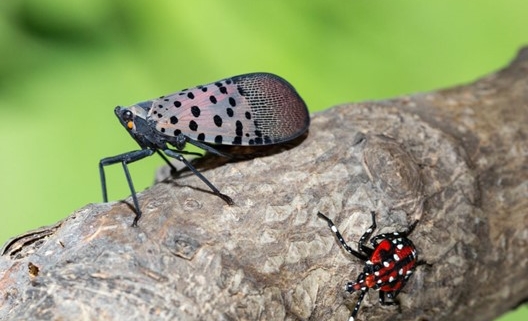
This report is in PDF format which allows you to search for other pest like the hemlock woolly adelgid, and the spotted lanternfly..