

Thermodynamics in Lakes and Streams
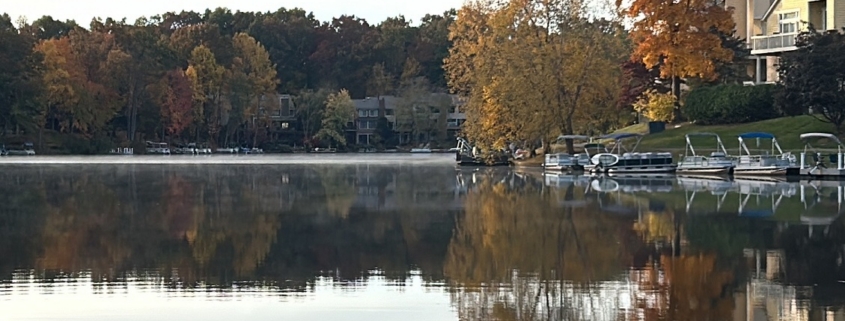
Feature photo: A Calm Day on Lake Audubon. But Thermodynamics still governs geochemistry in lakes such as the status of chemical reactions, temperature, pressure, pH, mineral precipitation/dissolution, and gas exchange.
Article and photos by FMN Stephen Tzikas
An understanding of thermodynamics as it relates to lakes and streams is an important concept for master naturalists.
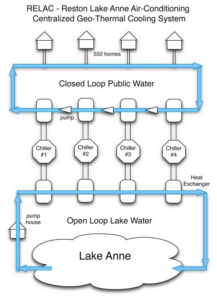
Illustration: https://hickoryclusterassociation.blogspot.com/p/relac.html
In a beneficial role, thermodynamics can cause the layering of lakes creating an opportunity for air conditioning. The Reston Lake Anne Air Conditioning Corporation (RELAC) made use of this to provide green energy for residents from 1965 to 2025, before ceasing operations. The RELAC used a chilled water loop to provide cooling to building clusters in the Lake Anne area. The process involved a small central plant that cooled and distributed the chilled water. The Carrier Air Conditioning Co., introduced the concept at the 1939-40 World’s Fair. Heat picked up by the water in cooling household air was removed by water pumped from nearby Lake Anne. The heated water was pumped back to Lake Anne. The lake, 30-acres in size, was large enough to absorb the heat without significant temperature change.
However, there is a negative side to thermodynamic layering in lakes. In the summer, lakes can have harmful algal blooms (HABs), lasting from days to months. After a bloom dies, the microbes that decompose the dead algae consume and deplete oxygen, generating a “dead zone” which can kill fish. The hypolimnion is the dense, cold, and deep bottom water layer of a thermally stratified lake, located below the warmer, well mixed surface-level epilimnion. Isolated from atmospheric oxygen, these summer oxygen depleted (anoxic) “dead zones” can persist until fall turnover. The metalimnion, or thermocline, is the middle, transitional layer. It is characterized by a steep temperature decline, of about 10 °C. As surface water warms in the sunlight, it becomes favorable to cyanobacteria growth. The lack of mixing causes deep-water oxygen to be depleted by bacteria decomposing organic matter. This anoxic condition breaks down sediments, releasing phosphorus into the water, which serves as fertilizer for blooms. These HABs also create toxins impacting water quality.
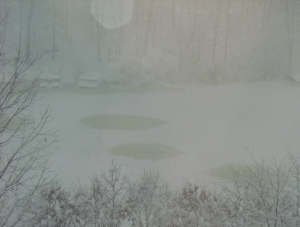
Ice circles on Lake Audubon (2/06/2010)
Moreover, thermodynamics can offer some rare, interesting phenomena. I live on Lake Audubon in Reston. In winter there is a phenomenon of ice circles. Ice circles are natural phenomena where circular slabs of ice rotate in slow-moving water, often found in lakes and rivers. They form when ice fragments in an eddy current, causing the ice to spin and be “lathed” into a circle by colliding with surrounding ice. In addition, the ice doesn’t melt uniformly. Impurities, air under the ice, hotspots and snow cover will affect how quickly it melts. If there’s less snow in an area, it will have less reflective surface than something completely covered in snow. It will therefore absorb more heat and melt faster. The ice could be so thin that it looks like water.
Finally, with climate change, thermodynamics plays a favorable role via tree canopies. Tree canopies regulate urban thermodynamics by cooling air temperatures up to 4–5°C through shading and evapotranspiration. A canopy cover of about 30% to 40% is most effective for mitigating urban heat island effects. Trees release water vapor through stomata. This conversion of liquid water to vapor consumes heat from the surrounding air. Tree leaves intercept solar radiation, reducing the absorption of heat by asphalt and concrete surfaces, and limiting radiation re-emission. Stormwater thermodynamics can be affected by climate change too. Thermal pollution caused by heated urban runoff can lead to thermal stratification in lakes, causing HABs. Stormwater runoff also collects and transports nutrient pollutants, such as nitrogen and phosphorus, from lawns, farms, and impervious surfaces, adding to the problem.
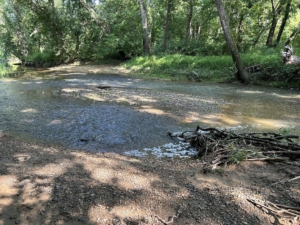
At a macroinvertebrate stream monitoring event, the tree canopy shading percent is recorded. This is estimated by considering the shade from streamside trees, shrubs, and grasses. Shading helps keep water cool and can be beneficial for aquatic life. In this photograph for Difficult Run site ID: DR34 (Leigh Mill Road, Great Falls, Difficult Run Stream Valley Park), on 7/20/2023 between 9-11:30 AM, the stream channel shade was estimated at 75% to full.