Posts

Pollinator Pathways Turn One in Northern Virginia

Photo: Plant NOVA Natives

Article by Eileen Ellsworth

One year ago, Plant NOVA Natives launched a Pollinator Pathway initiative. The original program was created by a group of highly credentialed environmentalists and conservationists in Wilton, Connecticut and expanded by PNN into Northern Virginia. Its goal is to address habitat fragmentation caused by human activity that has drastically reduced insect populations and degraded the environment. The program suggests ways a community, working together, could create “stepping stones” of native plants to connect these isolated fragments and build a feeding/sheltering/hosting corridor that insects can find and follow.

As a result of the Pollinator Pathway launch, several neighborhoods across the region took steps to build one. Many more native plants ended up in the ground, all of them strategically placed to help local pollinators find sources of food and shelter they so desperately need. Here are some highlights from the past year that may motivate action going forward.
You may recall that the program has two requirements for membership. First, have an existing native tree or a native plant pollinator garden on your property. Second, avoid the use of all broadcast pesticides, including mosquito fogging, which kills every native insect it touches – except the mosquitos’ own larvae! Those happily grow and hatch away in standing water, unfazed by the chemical.
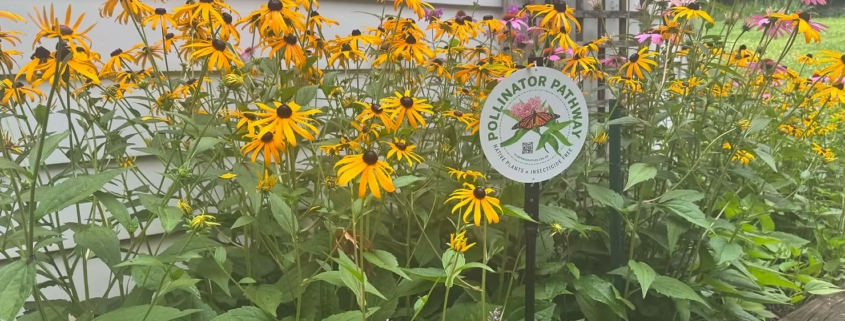
With these requirements in mind, several people in Fairfax and Arlington set out to start pathways, using the Pollinator Pathway signs to help attract interest. There have been many reports of curious neighbors and passers-by who stopped to inquire about the initiative. While the signs certainly helped educate, the program also fostered a deeper sense of community and a growing energy around the program’s goal.
For example, Margaret Fisher created a Pollinator Pathway in Clifton. She says, “It couldn’t have been easier. I had already gone door-to-door ten years ago or so to sign neighbors up for a ‘Bee Safe Neighborhood,’ where people pledged not to use neonicotinoid insecticides outdoors. We celebrated our neighborhood with a very fun block party. I have email addresses for some of those folks and was able to easily convince them to sign up for the Pollinator Pathway. The properties lead more or less contiguously to Chapel Road Park. Very few people in our area use mosquito spraying services, and I hope seeing the signs along the road may prompt them to cancel those services.”
Melania Flores took advantage of an existing effort to plant more canopy trees in her Ashton Heights neighborhood. She reached out to that group, giving her access to a wider neighborhood audience. She knocked on doors, created and printed flyers, and presented the topic at one of the monthly Ashton Heights Civic Association (AHCA) meetings. She also started writing a monthly article for her neighborhood newsletter to further engage and educate. All told, her efforts have garnered 24 Pollinator Pathway participants to date, and that number is growing. All of them have signs that broadcast the program. Melania has been invited to neighbors’ homes and the local church to consult on how they can help. She even offered some of her own native plants as a benefit of joining. And lastly, the entire neighboring community organized a “buckets of doom” initiative with mosquito dunks to help control mosquitos in an effective, environmentally friendly manner.

Sara Holtz recruited 95 properties to the effort, including parks in the Town of Vienna and Fairfax City. She tapped several friends and neighbors in the Miller Heights neighborhood of Oakton and conducted tabling efforts at events hosted by the Vienna Farmer’s Market, the Virginia Department of Forestry, and the Greater Oakton Community Association. She contacted Supervisor Dalia Palchik, Delegate Holly Seibold, and School Board member Melanie Meren to put signs in their gardens. Some local elected officials also promoted the endeavor in their newsletters at her request. The owner of The Virginian Restaurant agreed to put a sign in his garden next to the restaurant. She posted on the Native Vienna Facebook group reaching all homeowners who follow it. Many hundreds of local property owners were engaged and educated through her efforts.

Constance Chubb and Melinda Soltys both rallied their neighbors and friends, grew the program’s membership, and gave away many plants and signs. As for me, I also created a street-based initiative, recruiting eight friends and neighbors to join and display signs. In addition to planting more natives on our own properties, we coordinated on non-native invasive removal efforts in the community-owned park – a collection of wooded parcels that weave between our homes and throughout the neighborhood. Finally, we built a new, very visible pollinator garden on a street-side plot of mowed Japanese stilt grass. Figured we couldn’t go wrong with that one.
Turns out the effort can be as small or as large as you personally choose to make it. The goal is not a perfect carpet of native plants that stretches down the entire length of the street (though that would be amazing). Rather, it’s closing the gap between existing native plantings, which is certainly doable. Even the smallest effort of planting one new native helps. Arranging several new natives in a grouping is a substantial benefit. Either way, the Pollinator Pathway program has inspired important conversations and goal-oriented action, delivering on its promise to better feed and shelter our struggling pollinators and improve the biodiversity of the entire region.
Want to get involved? Visit the Pollinator Pathway page on the PNN website, check out the “Tips for Organizers,” and get started today.

Pollinator Pathways: Connecting your yard to the bigger picture

Photo: Plant NOVA Natives

Article by Eileen Ellsworth

Imagine the world as it once was. Verdant forests, buzzing meadows, and numerous other natural areas were immense, whole, and pulsing with life. Over time, human activity emerged and carved the natural world into disconnected, even isolated parts. Ecologists refer to this process as habitat fragmentation. You can see it in urban settings where green parks are biological islands surrounded by buildings and concrete roads. You can see it in rural settings where agriculture simplifies ecosystems and amplifies the populations of only certain insects to the detriment of others. You can see it in suburban settings where developments destroy natural habitats and where landscapes are “replaced” with all non-native species.

Large and mostly undisturbed ecosystems can still be found, of course, especially in our beloved national parks and forests. But even they are distant from each other, understaffed, and too small in total acreage to sustain the biodiversity of the continent. Any solution to the problem of habitat fragmentation and the resulting loss of biodiversity, therefore, must be found right here among the throng of human life – where we live, work and play.

Is it possible to reconnect isolated fragments in our urban, suburban, and rural settings to benefit pollinators and the creatures that depend upon them? That was the question that sparked the “pollinator pathway” concept in 2007 by Sarah Bergmann, an artist living in Seattle. As part of a social and ecological project, she envisioned and described a network of native gardens that could create a “pathway” to support pollinators. This core idea led to the creation of a nonprofit – Pollinator Pathway – by Donna Merrill, a conservationist from Wilton, Connecticut, in 2017. Since then, the group has helped inspire and launch a national movement.

The idea is a powerful one. Anybody can take part, even at a novice level. There are very few barriers to participation. If all you have is one native tree or a  small pollinator garden – preferably one with some native plants – it’s a start, and you can build from there.

The main goal of a pollinator pathway is to reinstate connectivity between several small but healthy habitats. A single native tree can support bees and other pollinators as much if not more than a flower garden. Building a pollinator pathway on your street, for example, may include adding a new native tree or two, or creating new healthy gardens on communal grounds or private property as “stepping stones” along the way. It may include the expansion of existing native plant areas. Removal of invasives that disrupt the pathway will certainly be part of the plan, along with pledges to avoid all broadcast pesticides including mosquito and tick sprays. Only unpoisoned ecosystems can be included in the work.

Many communities across America are already building pollinator pathways and proving the concept. You can recruit participants on your own, or have fun working with like-minded people to muster engagement. Hold a kick-off meeting to build some early momentum. Don’t over plan. Take some early action, starting with 1 or 2 easy planting projects, then see where it takes you.

On a new webpage just launched by Plant NOVA Natives you will find some handy tools to help you build a pollinator pathway in your neighborhood or community. They include:

  • A tip sheet for pollinator pathway organizers
  • Instructions for ordering medallion signs that will be delivered to your house from Plant NOVA Natives for you and your participants. If you are in Northern Virginia, we will have the sign company mail you the first five for free.
  • Ideas for how to pitch the idea to the folks you want to engage
  • Pollinator Pathway handouts to leave with your neighbor.

Join the movement! Let’s work with our neighbors and friends to connect the fragments, rebuild some beneficial habitats, and heal the everyday ecosystems that surround us. Their resilience is astonishing. New life, activity, and hope will certainly emerge, along with a new joy in being part of something much bigger than our own backyards.