Posts

Your Yard Can Help Save Our Streams

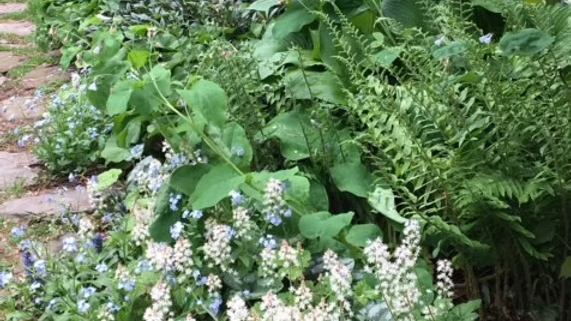
Dense plantings of native plants capture stormwater

Article and photo by Plant NOVA Natives

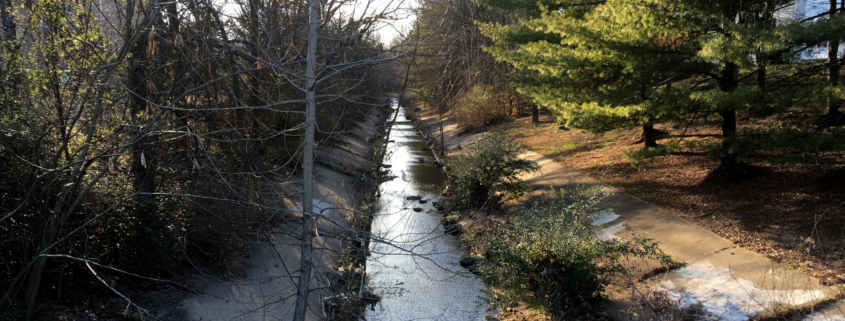
Northern Virginia’s stream and river water quality is not great. Although agriculture is the largest contributor by far of nutrient and sediment loads in Virginia’s streams, rivers, and the Chesapeake Bay,  urban and suburban stormwater runoff is the second largest and the fastest growing contributor to these pollutants.

Consider, for example, the 52 square mile Accotink Creek watershed in Fairfax. For several years, the U. S. Geological Survey (USGS) and Fairfax County have partnered to monitor pollutants in 20 watersheds across the County, including Accotink Creek. The good news is that nitrogen levels have generally dropped. But phosphorus concentrations have remained exceptionally high. Why? Because 87% of the Accotink Creek watershed is developed with 27% of the land covered in impervious surfaces. Such intensely developed regions produce large loads of sediment from stormwater runoff, and phosphorus is bound to sediment. Reduce the sediment levels in our local streams, and you will lessen the phosphorus pollution.
Both the Virginia Department of Conservation and Recreation (DCR) and the Virginia Department of Environmental Quality (DEQ) have announced focused efforts during 2026 to reduce nutrient-based pollutants and sediment loads in our water. By December of 2025 we had met 100% of our sediment reduction targets, which is excellent news. But we met only 80% of the nitrogen and 62% of the phosphorus reduction goals.

This is a compelling call to action for all property owners in the Plant NOVA Natives community. Here are several strategies to reduce nutrient pollution and sediment loads in our waterways:

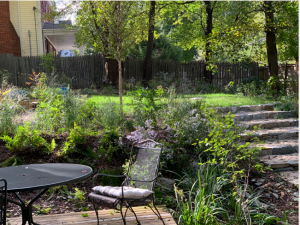
·   Plant more native plants, especially where stormwater tends to flow. Their deep roots stabilize the soil and absorb far more harmful nutrients than turfgrass lawns. Notice where stormwater tends to flow on your property along swales or slopes and plant there first.

·    Plant a street-side garden. Remember the underused strips of your property next to the street or sidewalk. These are ideal spots to add native plants, as their roots will catch stormwater overflow before it hits the pavement. Take care, however, to avoid underground lines, pipes, and overhead wires. And please consider whether your plantings impact people’s access to their cars, mailboxes, or safe crossing to the sidewalk. See Plant NOVA Natives’ comprehensive list of considerations for street-side gardens before you begin to dig.

·    Use organic compost. Ditching commercial fertilizers and using organic compost is always the best option to enrich the soil. But if you must use fertilizers, choose only phosphorus free or low-phosphorus brands and use them sparingly. 

·     Pick up pet waste: Nitrogen, phosphorus, bacteria like E. coli and Salmonella, parasites, and ammonia can all be found in pet waste! While pet owners often remember to pick up pet waste in public areas, remember to do so on your own property as well for the sake of our streams and rivers.

·    Compost and mulch yard waste: Composting and mulching are two strategies that effectively return nutrients to the soil and keep them out of stormwater. Grass clippings should be composted or mulched back into the lawn. Leaves are best left in non-lawn areas, but those that fall on the lawn can also be mulched or raked up and added to your compost pile. Keep lawn debris out of the street and away from storm drains.

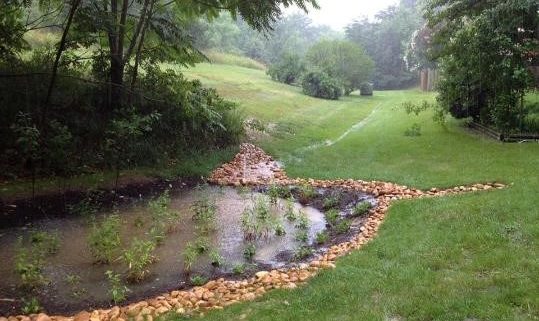
·    Create a rain garden: Rain gardens are landscaped areas constructed to capture and hold stormwater so that it seeps into the soil instead of running off our property. A link to a step by step guide on how to build a rain garden can be found here on the Plant NOVA Natives website.

·    Use rain barrels: If you can capture water from downspouts and use it later to water your plants, this greatly reduces stormwater runoff caused by our roofs. 

·     Redirect downspouts to vegetated areas rather than paved impervious surfaces: When rain barrels are not an option, try to redirect downspout water flow away from sidewalks and driveways and towards the more vegetated areas of your property. 

·    Reduce impervious surfaces: Replacing asphalt with gravel or permeable pavers will capture and keep more stormwater on your property. But reducing the lawn by converting parts of it to native plant gardens is also highly effective. Turf grass, while green, behaves more like concrete when it comes to water absorption.

·    Maintain septic systems: Regularly inspect and pump septic systems to prevent nutrient leaching into groundwater.

·    Wash cars responsibly: Either use a commercial car wash or wash your car on grass to filter soapy water before it enters the ground.

Additional strategies to capture stormwater are discussed here on the Plant NOVA Natives website, along with a discussion of planting and maintaining riparian borders. Finally, here is a link to a Fairfax County Soil and Water Conservation District manual with instructions on how to build and maintain rainwater gardens, green roofs, and more.  
 

Integrating Storm Water Management in Landscape Design, February 20th

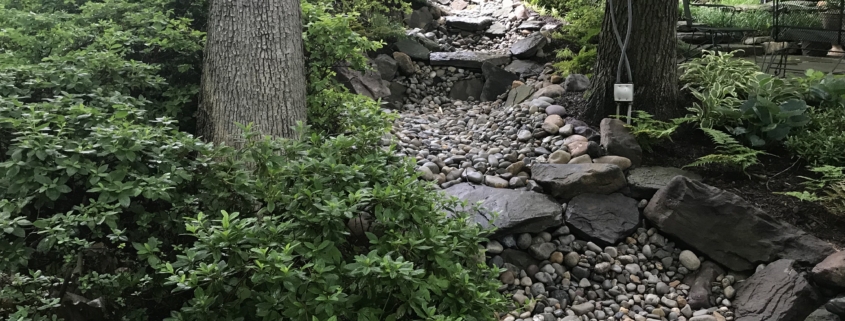
Step Pool Conveyance System photo from Green Spring Extension Master Gardeners

The 17th Annual EcoSavvy Symposium
Saturday, February 20, 2021
9:30am – 12:30 pm
Cost: $26 in-county/$28 out-of-county
Registration (703) 642-5173 or online at www.fairfaxcounty.gov/parks/parktakes
Code ITG.QARB

Learn innovative techniques to capture, store and collect rainwater.
Presented by VCE Green Spring Master Gardeners. Speakers are Dr. Laurie Fox, Horticulture Associate, Virginia Tech, Hampton Roads Agriculture Research & Extension Center and Christine Horner, Water Quality Engineer, Town of Vienna.
Also, a presentation on Virginia Conservation Assistance Program by Northern Virginia Soil and Water Conservation District.

Virtual Walk & Talk: Healthier Streams for a Healthier Community

Thursday, 10 September 2020
7-8:30 pm EDT
Register and learn more.

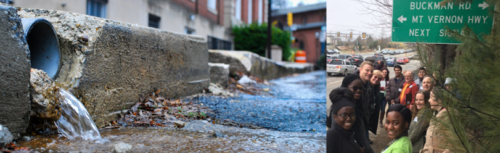
Join Fairfax County staff Charles Smith & JoAnne Fiebe for a virtual walk and talk about ideas for making a stream part of the community again. Sponsored in part by Audubon Naturalist Society, they’ll show videos of a recent site visit, talk with Charles and JoAnne about the vision for the Route 1 redevelopment, and talk about how, as we face bigger rain storms, redevelopment can be tied to creating healthier streams, and therefore a healthier world for us. Free.

Creating A Flood-Free Paradise: Managing Water in the Garden, program Mar. 2nd

Falls Church Garden Club
American Legion Hall
400 N. Oak Street, Falls Church VA
Monday, 2 March 2020
7:30 pm

Falls Church and Fairfax County have faced more than their share of flooding. Award-winning landscape designer and Falls Church resident Elisa Meara, founder/owner of the Native Plant Landscape Design Corp., will share before-and-after stories and photos of properties that have undergone conservation landscaping to manage stormwater and prevent erosion. She also may touch on rain gardens, infiltration trenches, swales and other approaches to water management, as well as provide a list of plants suitable to a wide variety of conditions.

Elisa Meara grew up in the Dominican Republic, where nature and plants always played a big role in her life. Living in a country where the weather allows people to enjoy the outdoors year-round, she became interested in the beautiful array of textures, colors, forms, fragrances and shades of the Dominican flora. This was the beginning of her passion for beauty and design. During the last fifteen years she has lived in five different countries. In each place, she faced the challenges that come with working with unfamiliar plants, soils, and weather, but says that the difficulties were always more than compensated for by the joy of learning and the adventure of working with things new and exotic. While living in England, Meara trained at the Inchbald School of Design, one of the most demanding and prestigious garden design programs in the world. As a certified Virginia Master Gardener who has worked as a landscape designer in England and Italy, she aspires to create personalized garden designs that support the local ecosystem. Her Native Plant Landscape Design Corp., launched in Falls Church in 2013, received the 2019 Virginia Conservation Assistance Program Leadership Award and has won Best of Houzz Service Award from 2016-2019. In 2019, the Chesapeake Stormwater Network awarded her 2nd place for Best Residential BMP in the Bay for a local project that captures and treats 100% of the runoff from the property.

Designing for big storms, big flooding: How can redevelopment help the Richmond Highway corridor?

Thursday, November 21, 2019
7:00-8.30 PM
Sherwood Hall Library
2501 Sherwood Hall Ln.
Alexandria, VA 22306

Host Contact Info: Renee Grebe | renee.grebe@anshome.org

Join us to discuss how we can redesign our landscapes to improve stormwater controls and restore streams in the Richmond Highway Corridor. Are we prepared for bigger downpours? How can redevelopment be tied to better stormwater control and creating wider stream buffers? How can you get involved to drive change?

Panelists:

  • JoAnne Fiebe, Program Manager, Community Revitalization | Fairfax County Department of Planning + Development currently working on the Embark Richmond Highway Urban Design Guidelines
  • Catie Torgerson, Planner IV, Stormwater Planning Division | Fairfax County Department of Public Works & Environmental Services
  • Betsy Martin, President of Friends of Little Hunting Creek

100th NVSWCD Green Breakfast, Sep. 14th

Fairfax County Government Center
12000 Government Center Parkway, Fairfax, VA
Saturday, 14 September 2019
8:30 am

Walking Tour of Fairfax County Government Center Stormwater Infrastructure

To celebrate the 100th Green Breakfast, you are invited to join us for a tour of the Fairfax County Government Center Stormwater Infrastructure.

Please Note: Special Location!
We will meet on the path at the start of the meadow behind and to the left of the main Government Center building, 12000 Government Center Parkway, Fairfax, Virginia 22035. View a map showing the meeting place.

Gather beginning at 8:30 am, the tour begins at 9:00 am
No prior registration required. No breakfast provided this time.

The Green Breakfast will return to its regular location and breakfast on Saturday, November 9, 2019.

If you have any questions, please contact the Northern Virginia Soil and Water Conservation District at conservationdistrict@fairfaxcounty.gov.

Rain gardens for homeowners workshop, Sep. 21st

Sully Government Center
4900 Stonecroft Blvd., Chantilly VA
Saturday, 21 September 2019
10am – 12 pm

Come to this FREE workshop to learn about designing and planting a rain garden at your home! Rain gardens, also known as bioretention areas, are attractive landscape features that allow rain water and snow melt to infiltrate into the ground. A layer of mulch and plants intercept water running off streets, driveways, and rooftops, slowing its flow and removing pollutants before the water reaches local streams, the Occoquan River and the Potomac River, which are drinking water supplies for the region. Speakers include specialists from Northern Virginia Soil and Water Conservation District. Registration is limited, learn more and register here.