
FCPA 2026 Outstanding Volunteer Awards

At its meeting on June 24, the Fairfax County Park Authority Board approved a resolution honoring 21 individuals as 2026 Outstanding Volunteers. These peer-nominated individuals were recognized for their dedication to their community and their invaluable service to the Fairfax County park system: (Three of the awardees are FMN)
* Avril Garland, Accotink Stream Valley Park, IMA Site Leader
* Jerry Nissley, Huntley Meadows Park, Educational Program and Special Event Assistant
* Carol Tretkoff, Hidden Oaks Nature Center, Resource Naturalist

FCPA 2026 Outstanding Volunteers – photo FCPA

The announcement continued by saying, “More than 10,770 volunteers contributed to the operation, preservation and conservation of Fairfax County parks in Fiscal Year 2026. They contributed 115,718 hours of volunteer service and their work is valued at over $3.98 million. The Park Authority could not function without the support and commitment of our volunteer force.
“Each year, our volunteers remind us of the extraordinary power of people coming together with purpose. Their commitment to restoring habitats, supporting programs, and caring for our parks creates a community where nature thrives and neighbors feel connected. Their impact reaches far beyond the work they do; it inspires all of us to imagine what’s possible when we serve something larger than ourselves,” said Park Authority Executive Director Jai Cole.
The Park Authority’s outstanding volunteers were honored with a special evening of music and celebration at the Volunteer Appreciation Night on Thursday, July 16, as part of the Government Center’s Evenings on the Ellipse Summer Concert Series.”

RAPTOR RAPTURE, September 12th

Photo: Courtesy of the Loudoun Wildlife Conservancy


Saturday, September 12, 2026
1:00 p.m.

Fort Hunt Park Pavilion A
8940 Fort Hunt Rd, Fort Hunt, VA

Free event no registration required – Spead the word

Learn about and get close-up looks at raptors, a family that includes owls, hawks and falcons when Secret Garden Birds and Bees will bring live birds to Fort Hunt Park. The birds were injured and have been rehabilitated but cannot survive on their own. This event is sponsored by the Friends of Dyke Marsh, and the U.S. National Park Service. This is a great event for kids of all ages.

Aprenda sobre las aves rapaces y disfrute de una experiencia de cerca con ellas. Las rapaces incluyen búhos, halcones y falcones. La organización Secret Garden Birds and Bees llevará aves vivas al Fort Hunt Park. Estas aves fueron rescatadas tras sufrir lesiones, rehabilitadas con éxito, pero ya no pueden sobrevivir por sí solas en la naturaleza. Este evento es patrocinado por Friends of Dyke Marsh y el Servicio de Parques Nacionales de los Estados Unidos. ¡Es una actividad excelente para niños y personas de todas las edades!


Freind’s of Dyke Marsh(FODM) Presents, Freshwater Fish and More, October 21

Photo: Courtesy of Mike Pinder, Various Minnow Species Gather to spawn on the nest of a bluehead chub.


Wednesday, October 21, 2026
7:00 PM

Virtual Learning Session

Registration is required but the event is free (see link below)

At FODM’s free, online member meeting on October 21, Mike Pinder will explore Virginia’s diversity of freshwater fishes, major family groups,
distribution, habitats and the unique behaviors of certain species.   He will also help participants learn how to see and identify this often
unnoticed and underappreciated group of Virginia’s wildlife. Pinder is the Aquatic Biologist for the Virginia Department of Wildlife Resources.   Pinder is the Aquatic Biologist for the Virginia Department of Wildlife Resources.

Register for this Zoom presentation at:
https://us06web.zoom.us/meeting/register/dpyqnOJqRKC69xcYs6g0kQ#/registration.


Calling Citizen Science Volunteers – Urban Heat Island Mapping Project, July 8-24

Logo: FACS and GM Urban Heat Island Mapping Project

The Faith Alliance for Climate Solutions (FACS) and GMU are jointly coordinating an Urban Heat Island Mapping project and need citizen science Volunteering support.
This initiative will map temperature variations in the Fairfax County, Arlington, and the City of Alexandria area. Extreme heat is the leading cause of weather-related mortality in the United States and can vary dramatically depending on many factors like tree density.
Citizen scientists will collect data using temperature and humidity sensors along provided routes on “Measurement Day” – which will occur in mid to late July when summer temperatures are historically at their hottest.
Sign up as a driver (need a car), a rider (to monitor the temperature sensor), or as a 2–3-person team to handle both. There are 3 time slots during the day; you can volunteer for all 3 (preferred) or just one, and you can select the area you’d like to monitor. FMN Students can receive service hours and training will be provided.

Volunteer Expectations:

  • Watch the recorded volunteer training before your assigned shift(s).
  • Each team is responsible for picking up a sensor and measurement equipment from a designated pickup location prior to the Measurement Day. Flexible pickup arrangements may be available if needed.
  • Drivers and Riders should coordinate with their team prior to Measurement Day to figure out transportation and logistics. Arrive on time and be prepared to complete your assigned route.

From Concerts to Conservation: Enhancing Wildlife Habitat at Wolf Trap

Photo: by FMN Kathy Stewart, Blue Bird Box at Wolf Trap

Many readers may be familiar with Wolf Trap National Park for the Performing Arts (that’s its official name!) in Vienna, Virginia.  Perhaps, you’ve attended concerts while picnicking on the grounds and enjoying the bucolic setting.  But, Wolf Trap is not only an entertainment venue but also a full-fledged Park in its own right, with several miles of hiking trails, pollinator gardens, a Woodland Garden and Wildlife sanctuary, and a robust monthly schedule of nature-oriented activities, facilitated by the Friends of Wolf Trap. The Friends also monitor the bluebird nestboxes and Purple Martin gourds following recommended practices, and report the data on Nestwatch.

Wolf Trap’s 16 bluebird boxes and 12 Purple Martin gourds are occupied most of the season.  “Real estate” is in short supply, like everywhere else, and these dwellings are in high demand!  Thirty-eight Bluebirds have fledged this season so far, and the gourds currently cradle 59 Purple Martin eggs.  The usual assortment of chickadees, tree swallows and house wrens vie for the nestboxes, also, with eggs and hatchlings in progress and fledglings already on the wing.  It’s a lively and diverse neighborhood!

But, like many neighborhoods, it’s nearing the end of its lifecycle and could use some “sprucing up.” Many of the nestboxes are severely weathered, in poor repair, and lack noel guards and snake baffles.  It’s been my dream for some time to improve the comfort, safety and security of the nestboxes, but where to acquire the funds and labor?

An opportunity presented itself recently to make this dream a reality.  A Virginia Bluebird Society member was offering free, Scout-constructed, bluebird nestboxes with noel guards and snake baffles for the asking!  As the leader of the Wolf Trap Bluebird Trail, this was too enticing to pass up.  Soon, I was transporting new boxes and snake baffles to my home.

The plan is to replace the weathered boxes in the Fall after the nesting season is over.  As it turned out, the new boxes arrived just in the nick of time when Box #16 disappeared from the meadow (affectionately called “The Dimple”) in front of the entrance to the Filene Center.  Grounds maintenance had been cleaning up the Dimple with heavy equipment, and it’s likely the box was knocked off the pole and swept up in the debris.  Replacing Box #16 was a great opportunity to learn what will be entailed when we replace the remaining boxes using a team of Fairfax Master Naturalists, Scouts and other interested persons later this year.

Wolf Trap in the last few years has really stepped up its game in terms of improving its buildings and adding facilities that serve all types of patrons.  It seems only fitting that the nestboxes show the same pride of place, and now they will!  Wolf Trap is truly a place where not only performers and patrons, but nature itself, comes out to play — and that includes, of course, the cavity-dwelling Bluebirds, Purple Martins, and others.

Photo: by FMN Kathy Stewart, Blue Bird Box at Wolf Trap 2


Kathy Stewart
Certified Fairfax Master Naturalist
Board Member, Friends of Wolf Trap

Survey: Occoquan Bay NWR Butterfly and Dragonfly, July 3rd

Photo credit: Ana Ka’ahanui, Halloween pennant dragonfly

Friday, July 3, 2026
8:30 AM – 12:00 PM
Occoquan Bay NWR
13950 Dawson Beach Road
Woodbridge, VA, 22191

Butterfly and dragonfly surveys are carried out in temperate months (April-October), normally on Friday mornings, at one of four sites around Occoquan Bay, all within the 15-mile diameter circle established for the annual North American Butterfly Association’s Annual Count.

Note: The usual 8:30 AM start time may be changed to 8:00 AM during hot weather (typically July and August). Check the website for time changes.

The results of these surveys are made available to the participants and other interested individuals and agencies, including the Fairfax County Park Authority, the Northern Virginia Regional Park Authority, and agencies of the U.S. Interior Department. The results of the butterfly-dragonfly surveys are summarized, along with the results of the general surveys, in an annual report.

Participation is limited. Email Jim Waggoner at jwagge3093@aol.com to RSVP or for more information.

Additional details can be found on the Northern Virginia Bird Alliance website.


Survey: Metz Wetlands Butterfly and Dragonfly, July 10th

Photo credit: Juan Gonzalez

Friday, July 10, 2026
8:30 AM – 12:00 PM
Metz Wetlands
15875 Neabsco Road
Woodbridge, VA, 22191

Butterfly and dragonfly surveys are carried out in temperate months (April-October), normally on Friday mornings, at one of four sites around Occoquan Bay, all within the 15-mile diameter circle established for the annual North American Butterfly Association’s Annual Count.

Note: The usual 8:30 AM start time may be changed to 8:00 AM during hot weather (typically July and August). Check the website for time changes.

The results of these surveys are made available to the participants and other interested individuals and agencies, including the Fairfax County Park Authority, the Northern Virginia Regional Park Authority, and agencies of the U.S. Interior Department. The results of the butterfly-dragonfly surveys are summarized, along with the results of the general surveys, in an annual report.

Participation is limited. Email Jim Waggoner at jwagge3093@aol.com to RSVP or for more information.

Additional details can be found on the Northern Virginia Bird Alliance website.


Firefly Walk, July 5th

Photo credit: Terry Priest

Sunday, July 5, 2026
Time: 8:00–10:00 p.m.
Location: Huntley Meadows Park, Alexandria
Cost: $12 per person

The program is open to participants ages 5 and older.

Join naturalists at Huntley Meadows Park for an evening Firefly Walk and discover the fascinating world of these bioluminescent insects. Participants will explore park trails at dusk while observing fireflies and learning how they use flashes of light to communicate, attract mates, and navigate their environment.

Additional details and registration information can be found on the Fairfax County Park Authority website.


Native Bees and Native Plants: Partners in Pollination, A Zoom Presentation with Barb Abraham, July 23rd

Photo credit: Jane E. Ogilvie

Thursday, July 23, 2026
7:00 pm – 8:00 pm
Location: Zoom

Join the Virginia Native Plant Society for an engaging online presentation exploring the fascinating relationship between native bees and plants. Dr. Barb Abraham will introduce participants to Virginia’s native bee families, their life cycles and nesting habits, pollination behaviors, and the challenges these important pollinators face. The program will also cover practical principles for creating bee-friendly gardens that support native pollinators.

Dr. Abraham is an ecologist, educator, and longtime advocate for pollinator conservation. After more than three decades of teaching biology and conducting research on spiders and native bees, she helped lead Hampton’s designation as a Bee City USA affiliate in 2019. This presentation is a great opportunity for naturalists, gardeners, and anyone interested in supporting native pollinators in their own community.

Additional details can be found on the Virginia Native Plant Society website


Thermodynamics in Lakes and Streams

Feature photo: A Calm Day on Lake Audubon.  But Thermodynamics still governs geochemistry in lakes such as the status of chemical reactions, temperature, pressure, pH, mineral precipitation/dissolution, and gas exchange.

Article and photos by FMN Stephen Tzikas

An understanding of thermodynamics as it relates to lakes and streams is an important concept for master naturalists.

Illustration: https://hickoryclusterassociation.blogspot.com/p/relac.html

In a beneficial role, thermodynamics can cause the layering of lakes creating an opportunity for air conditioning.  The Reston Lake Anne Air Conditioning Corporation (RELAC) made use of this to provide green energy for residents from 1965 to 2025, before ceasing operations. The RELAC used a chilled water loop to provide cooling to building clusters in the Lake Anne area. The process involved a small central plant that cooled and distributed the chilled water.  The Carrier Air Conditioning Co., introduced the concept at the 1939-40 World’s Fair. Heat picked up by the water in cooling household air was removed by water pumped from nearby Lake Anne. The heated water was pumped back to Lake Anne.  The lake, 30-acres in size, was large enough to absorb the heat without significant temperature change.

However, there is a negative side to thermodynamic layering in lakes.  In the summer, lakes can have harmful algal blooms (HABs), lasting from days to months. After a bloom dies, the microbes that decompose the dead algae consume and deplete oxygen, generating a “dead zone” which can kill fish. The hypolimnion is the dense, cold, and deep bottom water layer of a thermally stratified lake, located below the warmer, well mixed surface-level epilimnion. Isolated from atmospheric oxygen, these summer oxygen depleted (anoxic) “dead zones” can persist until fall turnover.  The metalimnion, or thermocline, is the middle, transitional layer. It is characterized by a steep temperature decline, of about 10 °C.  As surface water warms in the sunlight, it becomes favorable to cyanobacteria growth. The lack of mixing causes deep-water oxygen to be depleted by bacteria decomposing organic matter. This anoxic condition breaks down sediments, releasing phosphorus into the water, which serves as fertilizer for blooms. These HABs also create toxins impacting water quality.

Ice circles on Lake Audubon (2/06/2010)

Moreover, thermodynamics can offer some rare, interesting phenomena. I live on Lake Audubon in Reston. In winter there is a phenomenon of ice circles. Ice circles are natural phenomena where circular slabs of ice rotate in slow-moving water, often found in lakes and rivers. They form when ice fragments in an eddy current, causing the ice to spin and be “lathed” into a circle by colliding with surrounding ice.  In addition, the ice doesn’t melt uniformly. Impurities, air under the ice, hotspots and snow cover will affect how quickly it melts. If there’s less snow in an area, it will have less reflective surface than something completely covered in snow.  It will therefore absorb more heat and melt faster.  The ice could be so thin that it looks like water.

Finally, with climate change, thermodynamics plays a favorable role via tree canopies.  Tree canopies regulate urban thermodynamics by cooling air temperatures up to 4–5°C through shading and evapotranspiration. A canopy cover of about 30% to 40% is most effective for mitigating urban heat island effects. Trees release water vapor through stomata. This conversion of liquid water to vapor consumes heat from the surrounding air.  Tree leaves intercept solar radiation, reducing the absorption of heat by asphalt and concrete surfaces, and limiting radiation re-emission. Stormwater thermodynamics can be affected by climate change too.  Thermal pollution caused by heated urban runoff can lead to thermal stratification in lakes, causing HABs.  Stormwater runoff also collects and transports nutrient pollutants, such as nitrogen and phosphorus, from lawns, farms, and impervious surfaces, adding to the problem.

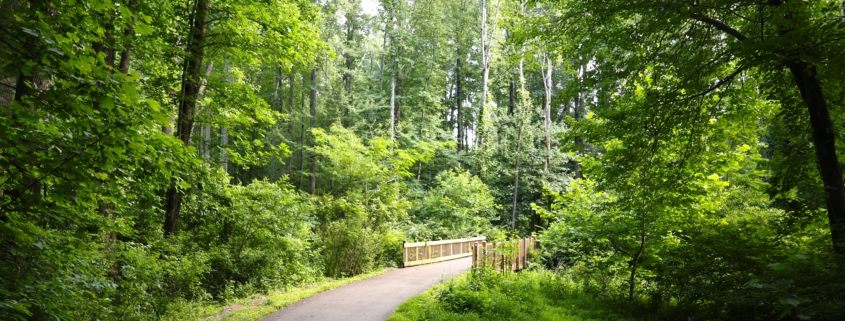
At a macroinvertebrate stream monitoring event, the tree canopy shading percent is recorded. This is estimated by considering the shade from streamside trees, shrubs, and grasses. Shading helps keep water cool and can be beneficial for aquatic life. In this photograph for Difficult Run site ID: DR34 (Leigh Mill Road, Great Falls, Difficult Run Stream Valley Park), on 7/20/2023 between 9-11:30 AM, the stream channel shade was estimated at 75% to full.