Project FeederWatch Workshop, Nov. 9th

National Wildlife Federation
11100 Wildlife Center Drive, Reston 20190
Saturday, 9 November 2019
9 – 11 am

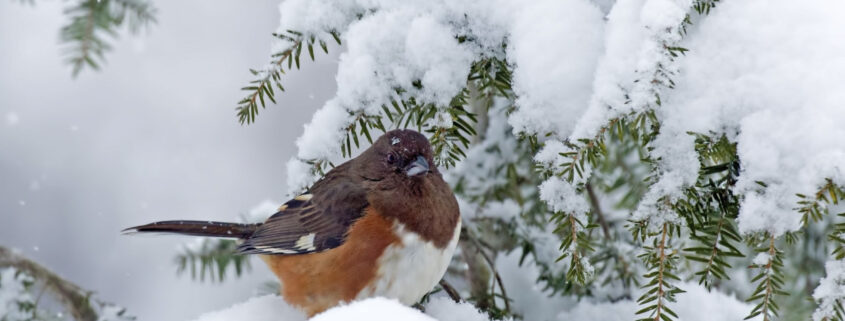
Project FeederWatch is the easiest citizen science you will ever do! From the comfort of your home, you simply count the winter birds that visit your feeders and report your data to Cornell Lab of Ornithology.

This FREE workshop will cover a bit of the history of Project FeederWatch, its purpose, tips for identifying birds, and the protocols to be followed while counting. We’ll spend some time practicing with the birds at the ASNV feeders. Light refreshments will be served.

Instructor: Carol Hadlock, volunteer extraordinaire and pioneer with the Audubon at Home program, will instruct this workshop.

Although the workshop is FREE, registration is required.

Virginia Working Landscapes fall workshop: Supporting wildlife in winter

Photo: Lori Scheibe

November 22, 2019
9:00 am – 02:00 pm
Smithsonian Conservation Biology Institute
1500 Remount Road, Front Royal, Virginia

Category: Workshops

Join Virginia Working Landscapes for an informative workshop to learn how to optimize your property to promote habitat for native biodiversity through our coldest winter months!

The morning will include lectures from:

  • Dr. Amy Johnson, Virginia Working Landscapes, on how to support overwintering birds.
  • Dr. T’ai Roulston, Blandy Experimental Farm, on what pollinators need during the winter months and how you can help.

The afternoon will include a field trip to (address provided closer to event date for registered attendees) to see some of the winter habitat features discussed in the presentations.

More details coming soon….but don’t wait to reserve your seat! Event is Free but registration is required.

Please note: No pets allowed at SCBI

REGISTER HERE

Lead and contribute to FMN Chapter committees in 2019 and 2020

Photo: Ana Ka’Ahanui

From President Joe Gorney to Chapter Members,

As a volunteer organization, our chapter succeeds based on the collective efforts of many people participating in an array of service activities. The same is true of the management of our chapter. At the end of this year, we will have a significant number of people rotating out of Board positions. Please consider serving on the board as an officer or committee chair, or as a member of a committee.  Your perspectives and ideas are enormously valuable.  Serving in one of these positions would take only a few hours each month but would be invaluable in helping our chapter to thrive.  And all of these hours count toward your service hours! Please submit your expression of interest to Fairfax Chapter Virginia Master Naturalists. Don’t delay!

Listed below is a description of the respective officer and committee chair positions. And if you’re not ready to be an officer or committee chair but would still like to help, you can still be a part of a committee as a member.  (We would especially like to have a diversity specialist under the Outreach Chair).

Secretary (officer)

Solicits board meeting agenda items; posts meeting agendas; takes and records meeting minutes; maintains chapter bylaws and handbook. Keeps us all accountable and working together!

Treasurer (officer)

Maintains the budget and accounting records; produces a monthly financial report; pays bills; collects dues; presents the financial records for audit; coordinates with committee chairs to produce the annual budget. Allows us to spend our money wisely to accomplish our mission!

Hospitality  (committee chair)

Coordinates general member meetings and basic training graduation activities including logistics, activities, and refreshments; orders and manage sales and/or distribution of fundraising items and logo items if needed. A welcoming presence at our activities!

Outreach (committee chair)

Promotes the chapter and its mission through outreach activities; manages booth staffing for outreach events; opens the eyes of the community to our mission and our work; helps ensure a diverse membership; motivates others to become members. Keep our good works in the forefront!

Continuing Education (committee chair)

Identifies, solicits, and approves continuing education proposals based on the criteria provided by VMN; notifies members of approved opportunities; maintains a catalog/calendar of opportunities.  Help us all to stay motivated and sharp!

Membership (committee chair)

Leads a small, dedicated, and experienced team; responsible for maintaining FMN and VMN membership directories; tracks and issues service awards and certifications; serves as member of Student Selection Committee.  Help welcome new members and foster camaraderie among current members!

Service (committee chair)

Approves service project proposals using established criteria; notifies members of opportunities; maintains a diverse catalog of opportunities. Help us all to serve our community!

Communications (committee chair)

Maintains the chapter public website, newsletters, social media, and chapter email account. Leads three or four strategically-minded people who communicate effectively and enjoy keeping all of us in the know. Earn hours from the comfort of your home while connecting us all to the chapter!

Ecopsychology-a talk on the intersection of us and nature

Photo by Barbara J. Saffir (c)

Rust Library
380 Old Waterford Rd NW, Leesburg, VA 20176
Saturday, 5 October 2019
1 – 2pm

Dr. Laura Rodriguez will speak on Ecopsychology: From Nature as Other to Us as Nature.

Every day you hear or read news stories describing the ecological devastation of our time. You question, can I, one person in 7.7 billion, do anything to turn this tide? Yes, you can! Like a flock of starlings swooping, diving, and wheeling in the sky, you are vital to the forward movement of the whole.

The emerging field of Ecopsychology can point the way of individual thought and action which benefits the whole. Through Ecopsychology, as we expand our concept of “us as nature,” we can create change in the narrative of disconnection with nature and foster an ecological ethic of care for our communities and the world.

Dr. Rodriguez is on the faculty of Viridis Graduate Institute, an international graduate school for Ecopsychology. She has also spoken on this topic many times including at Science Alliance for Valuing the Environment, Lourdes University, OH; Mercy Health – St. Vincent’s Medical Center, Multidisciplinary Medical Grand Rounds, OH; and others. This program is presented by the Virginia Master Naturalists, Banshee Reeks Chapter.

World Migratory Bird Day film festival, Oct. 23rd

Photo (c) by Barbara J. Saffir.

NVCC Annandale Campus, Richard J. Ernst Community Cultural Center (CE) Forum and Theater
8333 Little River Turnpike, Fairfax, VA 22003
Saturday, 23 October 2019
9am – 3pm

9:30 a.m. – “ALBATROSS” – CE Theater
11:15 a.m. – 12:15 p.m. – Secret Life of Birds and Bees: Raptor Lecture, Live Owls – CE Forum
11 a.m. – 2 p.m. – Exhibitor Hall – CE Seminar Rooms
12:45 p.m. – Panel Discussion – CE Forum
1:30 p.m. “BIRD OF PREY” – CE Theater

Community Associations Supporting the Local Ecosystem

Article by Plant NOVA Natives

Homeowner and condominium associations make many of the decisions that will determine the future of the birds and butterflies of Northern Virginia. Not only do community associations set standards for landscaping on private property, they also own and control large amounts of community property, including much of what is left of the undeveloped land in Northern Virginia and the environmentally sensitive areas along many streams. In recent years, the managers and Board members of more and more community associations have started adopting practices that both increase home values and support our local ecosystem.

Each community has its own needs and standards, but there are some common themes. For example, most developments have lawn areas that require heavy inputs of chemicals and labor to maintain. Often these lawns came into existence not because they were needed but because sowing turf grass was the fastest way for the builders to prevent soil erosion after the area was regraded. In the long run, erosion and stormwater control would be managed better by naturalized areas. Excess lawns can be thoughtfully converted simply by planting more ornamental native trees and shrubs along the edges and gradually allowing them to fill in. Another common situation is lawn that is being mowed right down to the edge of a stream or pond, which results in contamination of the waterways from runoff. It is a simple thing to create a buffer of native plants, ideally 100 feet on either side, though any buffer is better than none. Yet another example is invasive plant management, a problem that might not have existed when the community was first developed but which by now has become an unavoidable component of responsible land stewardship.

Some communities enjoy a more relaxed look, while others prefer a more formal appearance to their landscaping. Either way, there are many opportunities for helping songbirds and turtles without any major change to the overall aesthetics. Among the hundreds of species of Virginia native plants that are available from nurseries, there are ample examples of those that conform to a conventional look. Healthy lawns can be maintained by using organic materials to enrich the soil and reduce the need for chemical applications.

To help residents and decision-makers in community associations explore the many options that are available to them, the Plant NOVA Natives campaign is hosting a series of short symposiums, starting on October 4 and November 2, which will be repeated over time to allow participation by representatives from the thousands of HOAs and condo associations in Northern Virginia. Details and registration can be found at https://www.plantnovanatives.org/symposiums-for-hoa-and-condo-assoc-. The campaign has also created a website section that outlines ideal practices, local resources and many examples of what local communities have already accomplished, often in a budget-neutral method. It can be much cheaper, for example, to control erosion by the strategic use of native plants than by digging trenches or building walls.

2019 Earth Science Week, Oct 13-19

From David B. Spears, State Geologist to Va Master Naturalists

Virginia Master Naturalists,

Since 1998, the American Geosciences Institute (AGI) has sponsored earth science week (ESW) during the month of October (www.earthscienceweek.org). This year, earth science week will be October 13-19. The theme of this year’s event is “Geoscience is for Everyone”, an exciting theme that encourages everyone to learn more about the earth sciences, regardless of their background, age, or ability. The Virginia Department of Mines, Minerals, and Energy (DMME) has been an active supporter of earth science week for several years https://www.dmme.virginia.gov/dgmr/EarthScienceWeek.shtml. This year we are again reaching out to our colleagues in Virginia to promote this important event.


There are several ways that your chapter can get involved:

  • Sponsor an event during earth science week. It could be aligned with one of the special days designated during earth science week that focus on earthcaches, science literacy, getting students outside, diversity in earth science, fossils, geologic maps, and archaeology. Learn more about these focus days by visiting http://www.earthsciweek.org/focus-days. If you let us know about your event, we will promote it on our web site as well.
  • Encourage your members to submit an entry to the ESW video or photography, contests, which are open to all ages. Entries are due by 5 PM on Friday, October 18. To learn more, visit https://www.earthsciweek.org/contests.
  • Obtain a free Earth Science Week kit from AGI by visiting http://www.earthsciweek.org/materials. These kits are full of posters, activities, and additional resources. A limited number of kits are also available for pick-up directly from the Virginia Department of Mines, Minerals, and Energy in Charlottesville or Big Stone Gap.

I hope you will be as excited about this event as I am. If you have any questions or need additional information, do not hesitate to contact DMME at (434) 951-6310.

Sincerely,
David B. Spears
State Geologist

Project FeederWatch Workshop, Nov. 9th

National Wildlife Federation
11100 Wildlife Center Drive, Reston 20190
Saturday, 9 November 2019
9 – 11 am

Project FeederWatch is the easiest citizen science you will ever do! From the comfort of your home, you simply count the winter birds that visit your feeders and report your data to Cornell Lab of Ornithology.

This FREE workshop will cover a bit of the history of Project FeederWatch, its purpose, tips for identifying birds, and the protocols to be followed while counting. They’ll spend some time practicing with the birds at the Audubon Society of Northern Virginia feeders. Light refreshments will be served.

Instructor: Carol Hadlock, volunteer extraordinaire and pioneer with the Audubon at Home program, will instruct this workshop.

Although the workshop is FREE, registration is required.

100th NVSWCD Green Breakfast, Sep. 14th

Fairfax County Government Center
12000 Government Center Parkway, Fairfax, VA
Saturday, 14 September 2019
8:30 am

Walking Tour of Fairfax County Government Center Stormwater Infrastructure

To celebrate the 100th Green Breakfast, you are invited to join us for a tour of the Fairfax County Government Center Stormwater Infrastructure.

Please Note: Special Location!
We will meet on the path at the start of the meadow behind and to the left of the main Government Center building, 12000 Government Center Parkway, Fairfax, Virginia 22035. View a map showing the meeting place.

Gather beginning at 8:30 am, the tour begins at 9:00 am
No prior registration required. No breakfast provided this time.

The Green Breakfast will return to its regular location and breakfast on Saturday, November 9, 2019.

If you have any questions, please contact the Northern Virginia Soil and Water Conservation District at conservationdistrict@fairfaxcounty.gov.

Raptor Education and Photo Encounter, Oct. 19th

Mason Neck State Park Picnic Area

Red-tailed hawk

7301 High Point Rd, Lorton, VA 22079

Saturday, 19 October 2019
Two sessions: 10am or 1pm
$65 for either of the two 90-minute sessions

Would you like the opportunity to photograph magnificent raptors from just 10 feet away? Imagine being close to owls and hawks with your camera in a natural outdoor setting.

The Friends of Mason Neck State Park and Secret Garden Birds and Bees are offering a unique opportunity to get up close to some beautiful birds. Participants will be able to photograph raptors up close. At least four raptors, including a Red-shouldered Hawk, a Red-Tailed Hawk, an Eastern Screech Owl and a Barred Owl, will pose for you on a natural looking perch. You’ll hear from Secret Garden Birds and Bees staff about each one of them, making this a learning experience as well.

This is a fundraising event that will help the Friends continue to present programs and work on projects in support of the Park. $40 of each registration fee is tax deductible to the extent permissible by law.

Space is limited to 20 participants per session, so don’t wait to register! Register at  Raptor Photo Session.