
Paleontology on the Trail
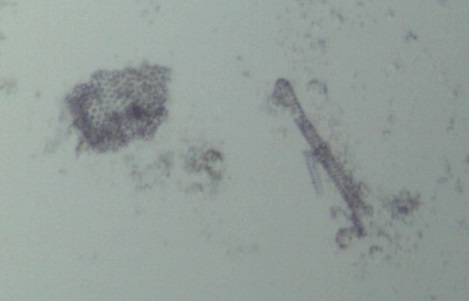
Diatom microfossil fragments at Brownies Beach, Maryland, magnified under the author’s microscope (Bausch and Lomb Stereo Zoom Microscope DD740). Diatoms are unicellular organisms and can be in various shapes.
Article and photos by FMN Stephen Tzikas
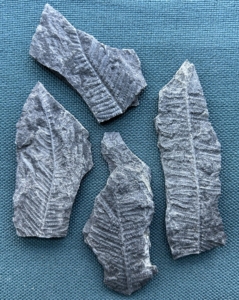
Anthracite fern fossils from Minersville, PA, commonly found in discarded coal piles in Schuylkill county, PA.
Fossils can be found on many trails. I have collected them from coal deposits in Schuylkill County, PA, in the Calvert Cliffs, Maryland area as part of a Northern Virginia Community College (NVCC) course, and here in Fairfax County at Holmes Run Gorge. The excursion to Holmes Run Gorge was also a NVCC geology field trip. For the latter, upon reaching the main gorge area, we encountered fine examples of boulders of bedrock that were piled.
The larger, lighter gray, rounded boulders are mostly Occoquan granite. The flatter layered slab-like boulders with square corners are Indian Run rock of metamorphosed sandstone. In the main gorge area we discussed quartz rocks. Quartz is the last mineral in the Bowen reaction series, which is a geological concept detailing the specific order in which minerals crystallize from cooling magma. I collected a sample of cloudy white milky quartz, which is extremely resistant to weathering. The cloudiness of milky quartz comes from microscopic inclusions of fluids that have been encased in the crystal from the time the crystal first grew.
Our NVCC professor showed multiple examples of Quartzite with “slashes” (see photograph below).
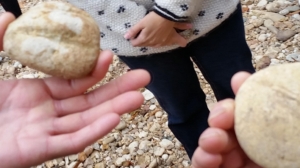
Skolithos Linearis fossils at Holmes Run Gorge
High-energy waters transported these cobblestone size rocks originating from the Harper’s Ferry Antietam Formation. This Quartzite was originally Quartz sandstone that underwent metamorphic changes. Most noteworthy were the Tubeworm line boroughs (the “slashes”), about a half billion years old. Samples were numerous and I took one with a dark patch, probably of magnesium oxide on it.
The fossil in the Holmes Run Gorge photograph is the Skolithos Linearis in well-cemented quartzite of the early Antietam Formation, found in Pennsylvania, Maryland, and West Virginia. The formation is largely quartz sandstone with some quartzite and quartz schist. Quartzite is a hard, non-foliated metamorphic rock that was originally pure quartz sandstone. Sandstone is converted into quartzite through heating and pressure usually related to tectonic compression within orogenic belts. These are Virginia’s oldest fossils and date to the Cambrian Period. Skolithos is a common trace fossil ichnogenus that is, or was originally, an approximately vertical cylindrical burrow. It was produced by a variety of organisms in shallow marine environments and appear as lineated features in sedimentary rocks.